The universal solution is not an app. It is a method
There is no tool that can solve every business problem. There is a method for turning context, events and decisions into intelligent operating platforms.
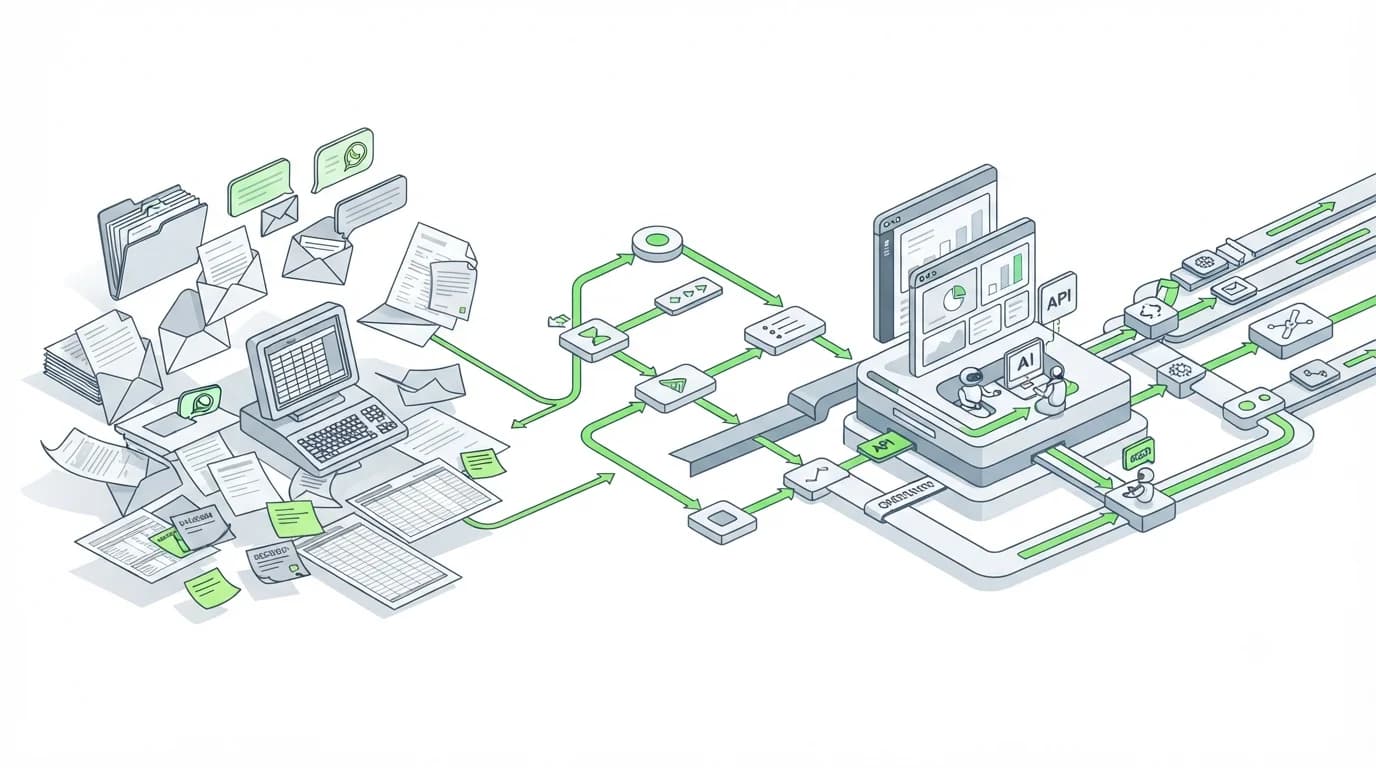
The promise of a tool that solves every business problem is comfortable. It is also false.
Every few years, a new version of that promise appears. First it was the total ERP. Then the CRM that would fix sales. Then the project management tool that would coordinate teams. Later came low-code, RPA, dashboards, copilots and now AI agents. The wrapper changes, but the underlying idea is the same: buy this platform and your operation will start working.
Real operations almost never accept that deal.
A company does not break because it needs one more screen. It breaks because its critical process is split across systems, people, documents, emails, exceptions and decisions nobody has turned into a shared operating logic. The ERP has one part. The spreadsheet has another. The key person knows the truth. Management decides with whatever it can reconstruct in time.
That is not a generic software problem. It is a context problem.
At SAUCO, we do not believe in a universal app. We believe in something less flashy and much more useful: a method for turning any observable problem into a specific, measurable and actionable system.
The universal solution is not a tool. It is a way of turning operational reality into software that works.
The mistake is looking for another tool
When a process fails, the first reaction is usually to buy something. Another module. Another licence. Another SaaS. Another connector. Another dashboard. Another AI layer on top.
From the outside, that makes sense. If the problem looks like disorder, a tool promises order. If there are too many emails, a tool promises centralisation. If the team depends on spreadsheets, a tool promises digitisation. If information arrives late, a tool promises visibility.
But the tool does not know why that spreadsheet exists. It does not know which exception it covers. It does not know which informal decision it protects. It does not know why users avoid the official system. It does not know why operations prefers calling Marta instead of checking the ERP.
That is where many projects bend out of shape. Software is implemented on top of a version of the business that is too clean. The vendor builds against the process described in the meeting, not the process that keeps the company moving at five in the afternoon when something gets stuck.
That is why so many companies end up with more tools and the same problem underneath. The real process is still outside. It just has more places to hide.
Every operating problem starts as poorly captured context
A business problem rarely arrives in a technical shape. It arrives as an uncomfortable sentence:
- "Only one person knows how to do this."
- "The real status is nowhere."
- "The ERP does not support this case."
- "Each department has its own version."
- "The order comes in by email, gets prepared in Excel and is confirmed on WhatsApp."
- "We do not know which offer is the right one until someone reviews it by hand."
None of that is fixed with another screen. First you have to capture the context: actors, data, states, rules, exceptions, permissions, legacy systems, decision points and signals of value.
That is context engineering. Not as a pretty theory, but as fieldwork. Understanding how the operation works when nobody is explaining it for a presentation. Seeing where the workaround appears. Asking why it exists. Deciding whether to remove it, formalise it or turn it into a rule of the system.
We develop this idea in our context engineering guide, but the short version is simple: if the context is not structured, neither software nor AI can operate on it.
AI amplifies what it finds. If it finds process, it multiplies capacity. If it finds chaos, it multiplies noise with a lot of apparent confidence.
The universal solution is a method
The method matters more than the technology category.
An order platform, an intelligent accounting solution, a project management system, a sales agent or an ERP integration layer may look like different products. Underneath, the serious work looks similar.
First you observe the real process. Then you break it down. Then you model states, events, data and decisions. You connect systems. You design permissions. You build a first version. You test it with users. You measure whether anything important changed. You harden it. You deploy. You learn.
That cycle is more universal than any app.
| Concept | What the market usually sells | What it means at SAUCO |
|---|---|---|
| FDE | Custom development with another name | Engineering embedded in the real operation |
| Event-driven | Technical architecture for IT teams | A system that reacts when the business changes |
| AI | Chatbot, copilot or internal demo | Capability inside a governed workflow |
| AaaS | A new acronym for selling agents | Agents with context, permissions, limits and traceability |
| Intelligent platform | Dashboard with automations | The operating layer where the process lives |
The difference is not semantic. It changes the outcome.
If you start with the tool, you force the business into someone else's structure. If you start with the method, you build a structure around how the business generates margin.
That is why the FDE is central. A Forward Deployed Engineer does not wait for perfect requirements. They enter the operation, understand the problem with users and decision-makers, translate reality into architecture and build software in production. They do not deliver a diagnosis and leave. They stay until the system works where it has to work: in real use.
From context to events
Once the context has been captured, the next step is to turn the process into events.
A company moves through things that happen: an order arrives, a status changes, an invoice comes in, a document is missing, an offer is approved, a delivery gets blocked, a lead responds, stock drops, an incident appears.
If those events do not live in the system, they live in someone's memory. And when they live in someone's memory, the company manages by chasing: messages, calls, meetings, follow-ups, manual checks.
Event-driven architecture is not only a technical choice. It is a way to stop constantly asking and start reacting when something changes. We already covered this in Event-driven architecture: why your system should react, not ask, but in operations the point is even sharper: the system should not wait for someone to remember to look.
An event can create a task, update a status, trigger a validation, notify an owner, sync an ERP, move information into a dashboard or launch an agent. The important part is that the process stops depending on human memory to advance.
That is when a management platform starts becoming intelligent. Not because it has AI on top, but because it understands what is happening and what should happen next.
Agents inside the flow, not floating outside it
AaaS, Agentic as a Software, Agentic as a Service or agentic software. The name may change. The useful boundary is not the acronym, it is where the agent lives.
An agent outside the process is a demo. It can answer well, summarise documents or suggest actions, but it operates from the outside. It does not know the complete rules, it does not have properly designed permissions, it does not necessarily leave enough trace and it does not always know what it can touch without breaking something.
An agent inside an operating platform is different.
It acts on data the system already understands. It respects states, permissions and limits. It works with real events. It leaves traceability. It asks for confirmation when the action is not reversible. It learns from patterns the process already produces.
This connects with an idea we covered in Your company doesn't need AI agents. It needs processes an agent can use: autonomy is not the first step, it is the last.
First the process. Then the platform. Then the agents.
An accounting agent can propose journal entries if it understands invoice, supplier, account, tax rule and human validation. A sales agent can prepare an offer if it knows margin, history, client, product and the correct version. A project agent can warn about blockers if the system knows which states exist, who owns each phase and which event marks a deviation.
Without that, AI only looks intelligent. With it, it starts producing.
How we industrialise this way of building
The FDE method works because it captures reality. The challenge is making sure it does not become unrepeatable craft.
That is why at SAUCO we are moving the method into our own cockpit: an operating guide for discovery, PRDs, flows, events, architecture, prompts, modules, deployments, documentation and maintenance.
The cockpit does not replace the FDE. It makes the FDE faster, more consistent and more precise.
Every project leaves more than a delivery. It leaves patterns, connectors, components, decisions, prompts, modules and lessons that can be reused in the next one. A specific solution does not have to be an isolated solution. It can feed a common base without losing adaptation to the client's context.
That is the important part: we do not want to grow like a consultancy that sells more hours. We want to turn a way of understanding operations into an AI-native FDE factory. Less promise. More production. Less demo. More payback.
This links to what we call the operating system of the business: a layer where the process stops living in patches and starts living in proprietary software. If you want to ground it in a concrete solution, you can review our guide to custom management systems.
Infinite wisdom, if we want to use that phrase, is not about knowing everything before starting. It is about having a way to look at any operation until its structure appears. Context. Events. Decisions. Actions. Measurement.
Any problem that can be observed, broken down, modelled, connected and measured can become a system.
Not a universal app. Something better: a proprietary solution that works with the company's reality, not against it.
If your operation depends on spreadsheets, key people and systems that do not talk to each other, the next step is not to buy another tool. It is to understand which method turns that chaos into capability. Book a session with us and we will look at your real case.