Your company doesn't need AI agents. It needs processes an agent can use
AI agents don't fail in the enterprise because the model is bad. They fail because they're set loose on a process that doesn't exist, with no guardrails and no one accountable for what they do. Autonomy isn't the first step, it's the last.
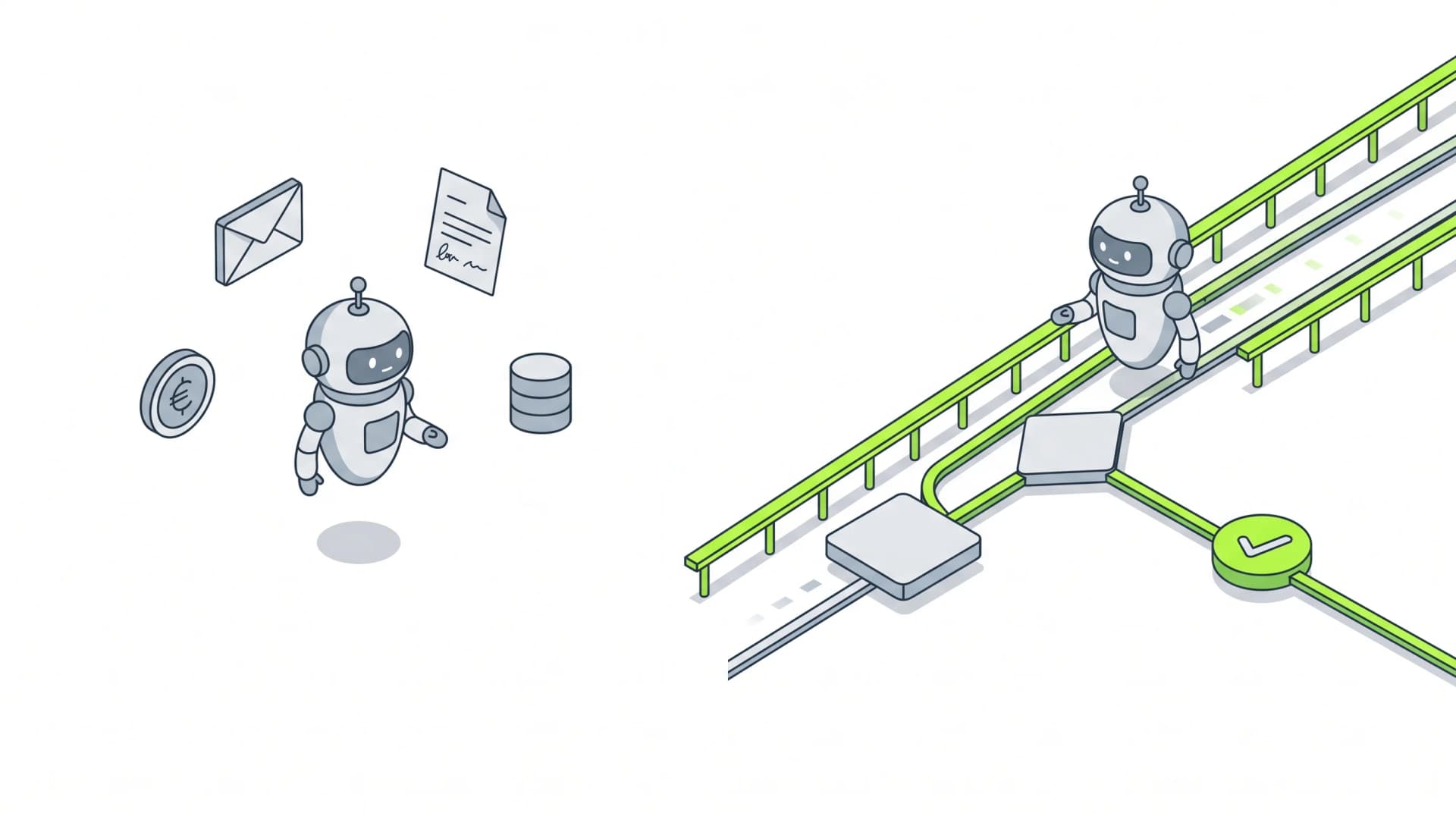
Over the last twelve months, "AI agent" has gone from a technical term to a checkbox in half the world's strategic plans. The boardroom conversation has shifted from "we should use AI" to "we need agents that work on their own." The jump happened without almost anyone asking what those agents are going to work on.
That's the problem. Most companies that want AI agents don't yet have the place where an agent can act with any sense. They want autonomy before they have process. It's like hiring someone very capable, very fast and who never sleeps, then dropping them into a company where nobody has written down how things get done. They don't fail because they're incompetent. They fail because there's nothing to hold on to.
What an agent actually is
It's worth separating two things that marketing mixes together on purpose.
A chatbot responds. You ask, it answers, and the decision to do something with that answer is yours. The risk is low because the agent touches nothing: it only talks.
An agent acts. It decides and executes: it creates the order, sends the email, modifies the record, triggers the payment, opens the ticket. The difference isn't intelligence, it's permissions. A wrong chatbot gives you a bad answer. A wrong agent leaves a mark in the real world that someone has to clean up.
This distinction changes the whole calculation. When a tool only suggests, it doesn't much matter if it's right 85% of the time, because a human filters. When a tool executes, that 15% error is no longer a discardable answer: it's a mis-placed order, a mis-billed client, a corrupt record that propagates.
A chatbot that gets it wrong costs you a minute. An agent that gets it wrong costs you the afternoon reconstructing what it touched.
Why they fail: there's no process underneath
The reason agent pilots stay pilots is rarely the model. The 2026 models are more than capable for most office tasks. The reason is that the agent gets deployed onto a vacuum.
For an agent to do anything useful without supervision, the process has to exist explicitly: what states an operation can have, what transitions are allowed, what validations block it, what happens when something falls outside the expected path. In most companies that process isn't written down anywhere. It lives in the heads of three people and in a habit that changes by the day.
A competent human navigates that ambiguity because they know it: they know "this client gets billed differently," "this supplier always runs late and it's fine," "this needs checking with production before confirming." The agent knows none of that. It only sees the data in front of it, and the data doesn't contain the exceptions that live in habit.
It's the same principle we develop in Garbage in, garbage out: AI doesn't fix a broken process, it runs it faster. With an agent the effect multiplies, because now the error doesn't stay on a screen, it becomes an action.
The right question isn't "is it capable?", it's "is it reversible?"
Before setting an agent loose on a task, the useful question isn't whether the model is good enough. It's whether the task meets three conditions. If it does, an agent adds real value. If it doesn't, you're introducing a risk that sooner or later comes due.
| Condition | Question | If NOT met |
|---|---|---|
| Bounded | Is the scope of the action clearly delimited? | The agent makes decisions outside its remit |
| Reversible | Can it be easily undone if it gets it wrong? | Every error is an incident someone cleans by hand |
| Observable | Is there a trace of what it did and why? | Nobody knows what happened until the damage shows |
A task that meets all three (classifying incoming emails, drafting an order for a human to confirm, reconciling two listings and flagging discrepancies) is ideal ground for an agent. The error is cheap, gets caught and gets reversed.
A task that fails any of them (executing payments without confirmation, changing prices in production, closing operations irreversibly) isn't a candidate for an autonomous agent, however capable the model is. There, autonomy isn't technological maturity, it's recklessness dressed up as innovation.
Most of a company's processes, looked at honestly, don't yet meet these three conditions. Not because they can't, but because nobody has modeled them to. And that's exactly the upfront work almost nobody wants to do.
The accountability hole
There's a question that almost never shows up in the demo and is the first to show up when something breaks: who answers for what the agent did?
When an employee makes a mistake, there's a clear chain: they made it, their manager reviews it, it gets corrected, lessons get learned. When an agent makes a mistake at three in the morning, executing a hundred operations a minute, that chain doesn't exist by default. If no traceability has been built (what it decided, with what data, under what rule), the error gets discovered late, with no context and no way to know how many more operations carry the same fault.
An agent with no traceability isn't an autonomous employee. It's an autonomous employee you've stripped of the manager, the time clock and the history. It works while it's right. The day it fails, nobody knows what happened.
That's why observability isn't an extra you add later. It's part of the definition of "agent ready for production." An agent that acts but leaves no auditable trace isn't finished, it's loose.
What you actually need first
The uncomfortable conclusion is that the order the industry sells is inverted. You don't start with the agent and find it a home. You start with the process and, once it's modeled, observable and fenced, the agent walks in almost on its own.
This ties directly to what we've already covered about building your business's operating system: when the process lives in the system (with explicit states, rules and traces), adding an agent stops being a risky project and becomes one more layer. The agent acts within guardrails the system already enforces, on data the system already keeps clean, leaving a trace the system already records.
To get there, someone has to go into the operation, see how it really works, map which tasks are bounded, reversible and observable, and build the scaffolding before setting anything loose. That's Forward Deployed Engineer work, not API integration. It isn't about connecting a model: it's about preparing the ground so an agent is safe. We lay it out in our guide to AI consulting for SMEs.
The agent is the end, not the beginning
Back to the boardroom question. "We need AI agents" is usually the right answer to a question nobody has asked: are our processes modeled so a machine can operate on them without breaking them?
In most cases, the honest answer is not yet. And that's not bad news: it's the real project. Modeling the process, cleaning the data, defining the guardrails and the traceability generates value on its own, with or without an agent. The agent, afterward, is the layer that picks up that work and turns it into real autonomy.
Whoever starts with the agent buys a demo. Whoever starts with the process builds a capability. The difference shows the first day something breaks at three in the morning.
If the conversation at your company is already "we want agents" but nobody has checked whether the processes are ready to support them, book a session with us and we'll look at it in concrete terms. The right starting point is almost never the one it looks like. We've seen how the ground gets prepared in our guide to administrative process automation.