We don't build software. We build your business's operating system
The core of our projects isn't an app that solves one specific problem. It's the platform the whole company runs on. And what makes it intelligent isn't the AI on top, it's the process modeled well underneath.
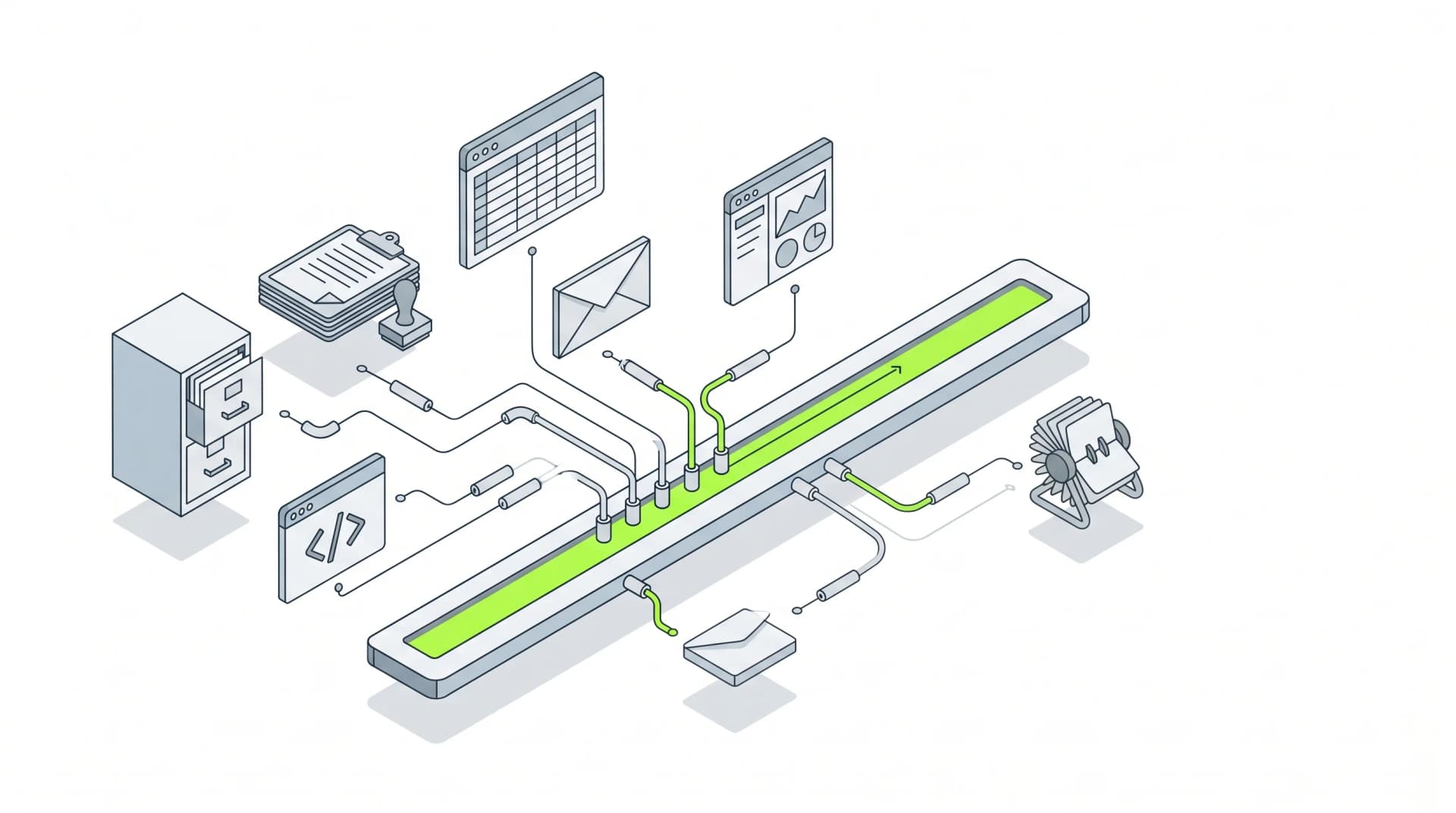
A client almost always asks for the same thing: "a tool to manage orders," "something to track hours," "a dashboard to see sales." A bounded piece that plugs one specific hole. What we end up delivering is rarely that. It's the place where the whole company starts to operate.
That gap between what gets asked for and what actually gets built isn't scope creep. It's how we work. We don't deliver an application that solves an isolated problem: we build the operating system the business runs on.
The phrase sounds big, so it's worth grounding it. We're not talking about a product, or a suite with a logo. We're talking about the layer of software that runs a company's real work: where an order comes in, how it gets validated, what it triggers in production, when it gets invoiced, what each person sees and what decision they can make. When that layer exists and is done well, the process stops living in people's heads and spreadsheets and starts living in the system.
From tool to backbone
A tool solves a task. A business operating system holds up the operation.
The difference isn't size, it's function. A tool can go down for a day and the business limps along through other channels. The operating system can't. When a company genuinely operates on its software, that software is as critical as the electricity or the financial ERP. It goes from being a line item in an IT budget to being the infrastructure that makes money.
The shift happens when software stops being a destination people go to in order to enter data and becomes the medium through which work happens. Nobody "uses" the operating system on their phone as a separate task. They use it for everything, without thinking. That's the bar.
| Software as a tool | Business operating system | |
|---|---|---|
| Function | Solves one specific task | Holds up the whole operation |
| Where the process lives | In heads, emails and parallel Excels | In the system, as the single source |
| If it goes down | The business continues via other channels | The business stops |
| Accounting nature | Recurring IT expense | Asset and productive infrastructure |
| Relationship with the user | They go to enter data | They work inside it |
| Systems needed for one operation | 5-8 disconnected | 1 with everything integrated |
That last row is the one that hurts most in practice. The typical mid-sized company doesn't have one system; it has seven that don't talk to each other.
Why it has to be integral
We described the cost of fragmentation in detail in The island company: each department with its own system, its own version of the data and its own bridge-person re-keying from one to the next. The problem isn't missing systems. It's that there are too many, and none of them has the full picture.
A business operating system isn't "yet another system." It's the opposite: it's the tissue that connects what's already there and removes the seams. Sales, operations, production, finance and management stop looking at different copies of reality and start looking at the same one. Not because someone syncs them overnight, but because there's a single place where the data is born and from which it gets distributed.
Being integral isn't a marketing adjective. It's a technical condition: if the system doesn't cover the process end to end, the islands, the parallel Excels and the re-keying come right back. Half an operating system isn't half the benefit. It's none of it, with the added complexity of maintaining it.
Who's in control
Here's the decision that almost never gets put on the table directly.
When a company buys an ERP or a vertical SaaS, the implicit contract is this: the software brings its own idea of how your business should work, and you adapt your operation to fit into it. It gets called "industry best practices," but in practice it means you bend your way of working until it fits the fields the software lets you fill.
That carries an invisible cost: you give up the part of your operation that sets you apart. If you've spent twenty years selling, manufacturing or serving in a specific way that works, and the software forces you to do it "like everyone else," you end up operating just like your competition, with the same factory KPIs and the same textbook flow.
The standard ERP doesn't ask you to improve your process. It asks you to replace it with a generic one your competitor also uses.
A custom operating system reverses the direction. The platform molds itself to your real process, not the other way around. The flow, the vocabulary, the stages and the rules are yours, the ones that generate your margin. This is what we at SAUCO call operational sovereignty: software that works in favor of how you already make money, instead of forcing you to change it. We've laid out how that reversal gets designed in our guide to the custom management system.
Where the "intelligence" comes from
The most misread part of the current moment is this: everyone sells "intelligent management," and it almost always means the same thing, bolting a chatbot on top of the data you already had wrong.
The real intelligence of a business operating system doesn't come from AI. It comes from having the process modeled well underneath. When the system knows what an order is, what states it can have, what rules govern it and how it relates to production and to collection, then it can start doing useful things on its own: warn before a shipment runs late, flag that a client has placed three orders below their average, block an operation that breaks the margin. That's operational intelligence, and it doesn't need a language model to exist.
AI, when it arrives, amplifies what's already there. If underneath there's a clean process and data that reflects reality, AI multiplies it. If underneath there's chaos and dirty data, AI multiplies the chaos, faster and with more apparent confidence. It's the principle we develop in Garbage in, garbage out: no model fixes a broken process, it just adds a coat of varnish that's harder to spot.
That's why order matters. First the operating system that captures the real process and turns it into reliable data. Then the intelligence on top. Doing it the other way around (AI first, the process "we'll fix later") is the most expensive way to solve nothing.
This only works if whoever builds it understands the business
A business operating system can't be specified in a meeting. Nobody can dictate from memory, in a room, how their operation really works, because much of that knowledge is tacit: it lives in what people do, not in what they say they do.
That's why the piece that makes this work isn't a technology, it's a role. Someone has to go into the company, sit next to the person doing the work, see where the real exceptions are (the ones that never show up in the official process diagram) and build software against that reality. That's a Forward Deployed Engineer: they don't design in the abstract, they design in presence.
The usual alternative (gather requirements, lock yourself away for six months, deliver) fails right here. It builds against the process the company thinks it has, not the one it actually has. The business operating system demands the opposite: building from the inside, with the real process in front of you.
How we build solutions
This is what defines the way we build: not software that solves a problem and sits in a corner, but the platform the whole company operates on, modeled around its process and able to become intelligent because it has the process done well underneath.
A company running on seven disconnected systems and a handful of irreplaceable people ends up with a single operational backbone. That's the outcome we go after on every project: software that stops being a collection of loose tools and becomes the place where the entire business runs.
If your company runs today on a collection of systems that don't talk, and every decision means reconciling three different versions of reality by hand, the problem isn't that you're missing one more tool. You're probably missing the operating system that ties them together. We go into this in depth in our guide to business process digitalization, and if you want to look at your specific case, book a session with us.