The Island Company: What It Really Costs When Your Systems Don't Talk
Most mid-size companies run as an archipelago: each department has its own tool, its own data, and its own version of the truth. The bridge between them is a person with a spreadsheet. That has a cost.
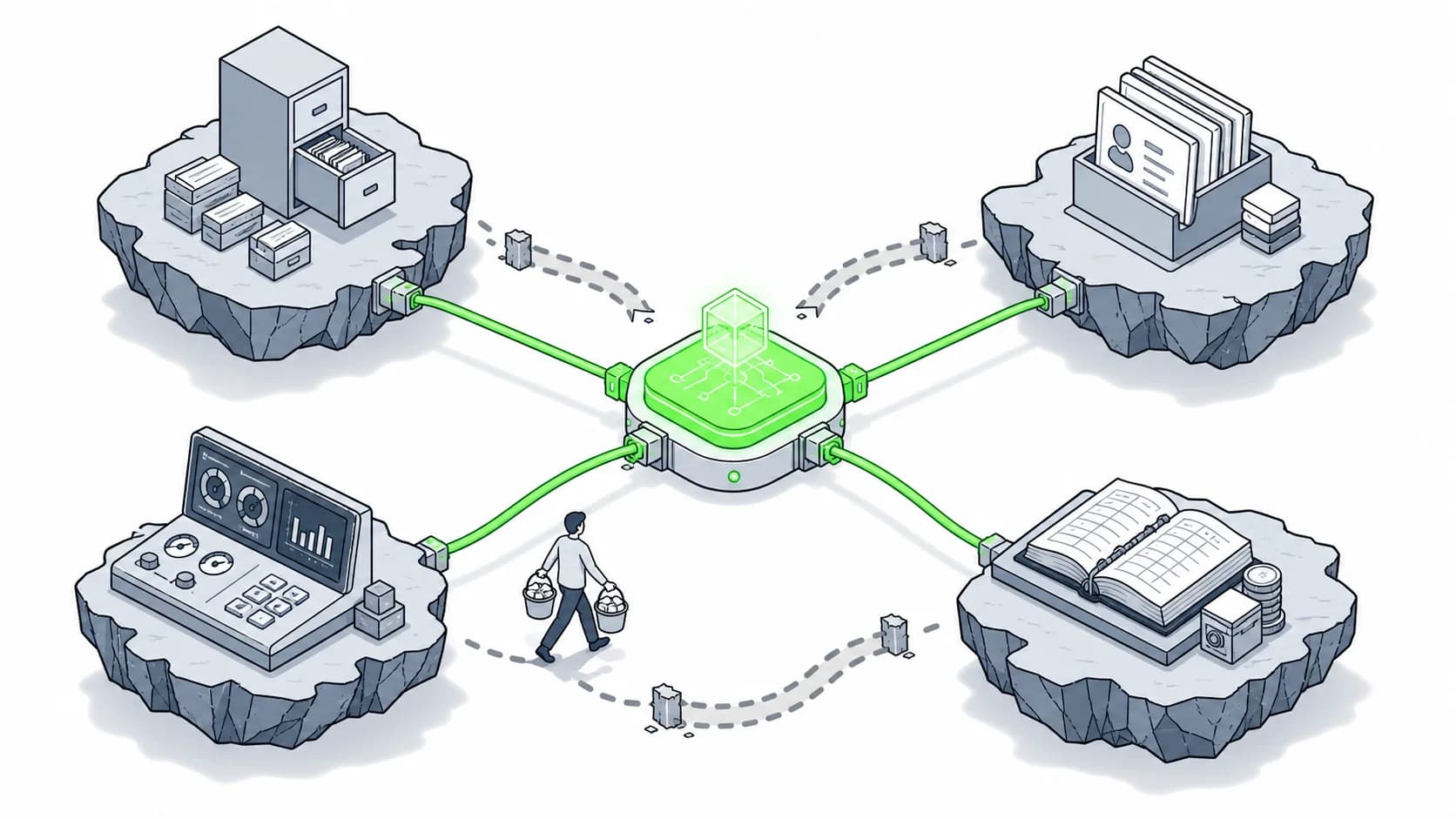
There are three different figures for the same data point in your company. One in the production system, one in accounting, one in the report someone exported on Tuesday. The real number is nowhere.
If that happens regularly, it's not a people problem. It's the symptom of a broken information architecture: systems that don't communicate with each other, and teams that act as human bridges to move data from one place to another.
The island company
Most mid-size companies arrive at this point without planning for it. They started with an ERP. Added a CRM when the sales team grew. Brought in a project management platform. Layered on billing tools, HR software, logistics systems. Every decision made sense at the time.
The result is an archipelago. Each system holds a partial truth. None has the full picture.
Customer data lives in the CRM. Billing history lives in the ERP. Project status lives in a third tool. And the actual state of operations lives in the spreadsheet someone updates on Fridays because no system has that view.
What each island costs
The cost doesn't appear in any budget line, but it's there. It distributes silently across several places:
| Cost type | Concrete example | Impact |
|---|---|---|
| Re-keying | Invoices copied manually between systems | Direct unproductive labor hours |
| Sync errors | Different figures depending on which system you check | Decisions made on incorrect data |
| Operational delays | Production doesn't know about an urgent order until someone calls | Missed deadlines |
| Manual reconciliation | Matching data between systems before a financial close | Extra days of work every month |
| Legal exposure | Stale customer data across different systems | Compliance risk in regulated contexts |
There's a detailed breakdown of re-keying costs in The Hidden Cost of Re-keying. The numbers that come out when you do the exercise properly tend to surprise people.
Two "solutions" that don't solve anything
When companies spot the problem, they usually reach for one of two partial responses.
The first is periodic export: someone writes a script that exports data from one system and imports it into another every night. It works until it fails silently, until formats change, or until volume grows and timing breaks down.
The second is no-code tools: Zapier, Make, n8n. They handle simple cases quickly. The problems arrive when business logic gets complicated, when you need audit trails for every transaction, or when volume exceeds what a generalist tool can handle reliably. What started as a simple flow becomes a tangle of steps nobody fully understands and nobody wants to touch.
Neither is integration. Both are patches with expiration dates.
What real integration actually requires
Real integration has three characteristics that patches don't.
It's bidirectional. If data changes in system A, the change propagates to system B. And if it changes in B, it propagates back to A. With conflict resolution logic when both change at the same time. We covered why this matters in Event-Driven Architecture: Why Your System Should React, Not Poll.
It handles errors. If the destination system is unavailable, data queues up and processes when it recovers. No data loss, no manual intervention.
It's auditable. Every transaction is logged: what data moved, when, from which system, with what value. Essential for financial compliance — or simply for knowing what happened when something breaks.
We've documented the full technical patterns in our guide to Bidirectional Systems Integration.
The problem with software that has no API
80% of the systems mid-size companies use don't have a modern API. Sector-specific software from 15 years ago, perpetual-license ERPs, production or logistics tools that export flat files.
The standard answer: "We'd need to replace it with something modern." A project that costs between €80,000 and €400,000, takes one to three years, and has a notable failure rate.
The alternative: if the system has a database — and every system has a database — you can read and write to it. If it exports CSV or XML, you process those automatically. If it has a web interface, you can automate it.
Most legacy systems can be integrated. What's missing isn't new technology: it's knowing how to build the right connector for the system you already have.
How SAUCO connects systems that don't talk
SAUCO operates as Forward Deployed Engineering. The team embeds in the client's operations, maps all the real data flows — not the ones in the procedure manual, the ones that actually happen — and identifies where the chain breaks.
The process always follows the same order:
- Full map of current systems and real data flows.
- Integration architecture design: what to connect, what pattern to use, what middleware fits the existing infrastructure.
- Custom connectors and APIs built with error handling, retries, and audit logging.
- Deployed in parallel with current operations. No system is cut over until the new one works.
- Post-deployment monitoring with alerts that fire before the team notices the failure.
The result: systems share a single version of reality. The team stops being the bridge.
See our complete guide to Bidirectional Systems Integration for full technical patterns.
Got disconnected systems that need a diagnosis? Book a session with engineering.