The hours you don't bill: automating timesheets, invoicing, and reporting in professional services
A 10-person consultancy can lose over €25,000 a year in unbilled admin time. The hours that go into manual timesheets, invoices, and reports are margin that never comes back.
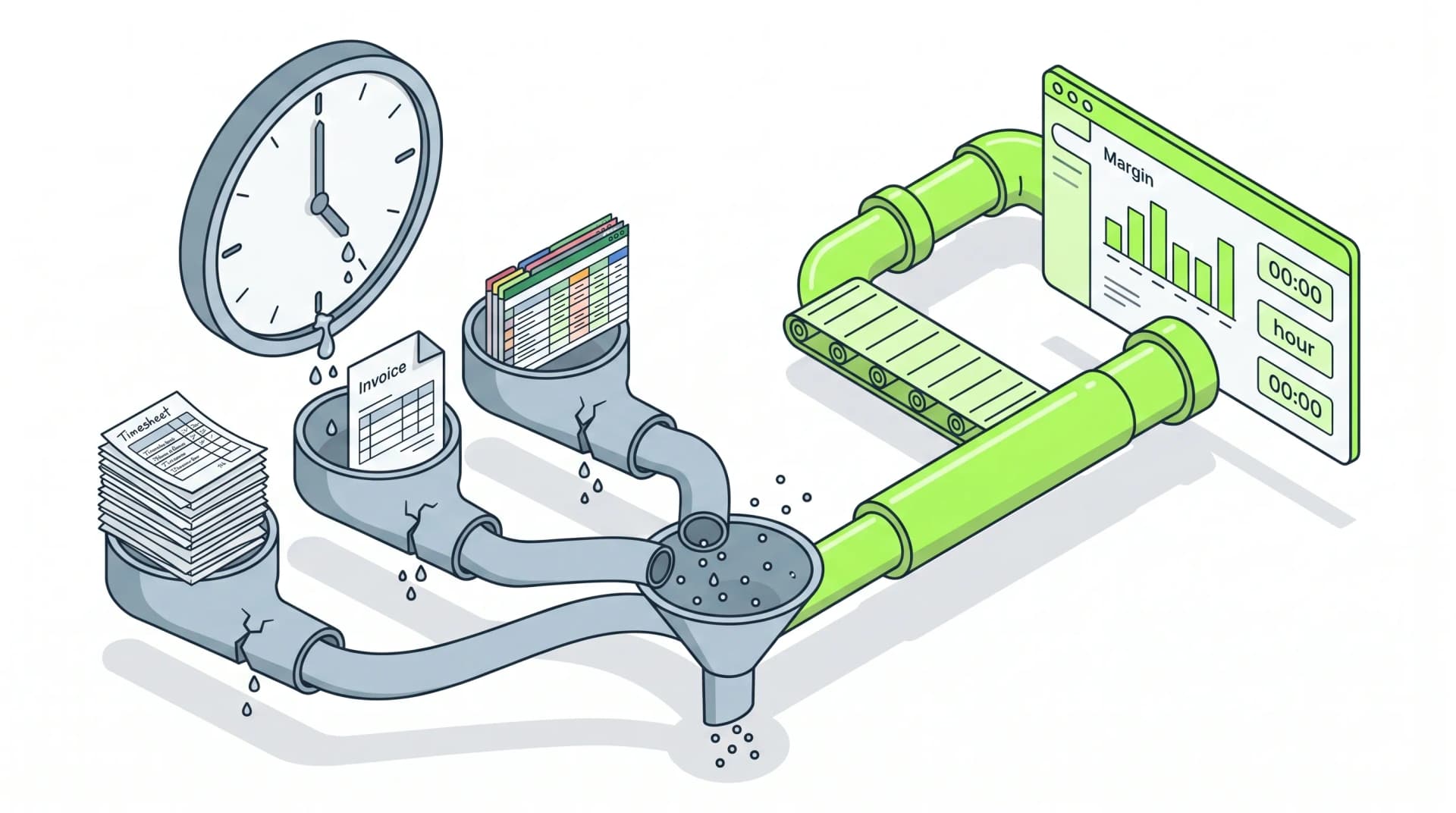
A ten-person consultancy, average rates of €80/hour, loses over €25,000 a year in non-billable time on internal admin. That's not a pessimistic estimate. It's basic arithmetic almost nobody actually runs.
Thirty minutes per person per day. Timesheets filled in at end of day — or Friday, which is worse. Invoices generated by exporting CRM data to Excel and copying it into a Word template. Monthly profitability reports assembled by stitching together tabs from different-coloured spreadsheets.
None of that time shows up in any P&L. It's not on any cost line. But it's eating the margin.
The invisible tax of administration
Professional services firms — consultancies, agencies, law firms, integrators — have a peculiar business structure. Their core asset is the time of skilled people. The unit of value is the hour.
And yet those same hours get spent on tasks requiring no specialist skill at all. Filling in a timesheet form. Exporting data from one system to another. Building a profitability slide by copying figures from four different sources.
Nobody calls it "margin erosion". It's called "the process". And the process has become normal.
The problem isn't that these tasks exist. It's that they're completely disconnected:
- Hours are logged in one tool (or a spreadsheet).
- Projects are managed in another (or the same spreadsheet, different tab).
- Invoicing happens in a separate programme, with data someone copies across manually.
- Profitability reporting gets built after the fact, pulling everything together by hand.
Every handoff between systems creates friction, delay, and errors that only surface when a client asks for a correction.
As we explored in The Hidden Cost of Re-keying Data, the cost of non-integration rarely shows up on the balance sheet but erodes margin steadily.
The three drains
Timesheets: the process everyone hates and nobody fixes
Time tracking is the first leak. In most service businesses the process runs something like this:
- The employee tries to remember what they did this week, with varying accuracy.
- They log it in a form, a shared spreadsheet, or whichever project management tool the team nominally uses.
- Someone reviews, consolidates, and exports for invoicing.
- Someone else cross-references against the budget.
Each manual handoff adds lag and inaccuracy. Projects get invoiced late because the data isn't ready. Hours get under-reported because the process is a pain. The actual project margin gets discovered weeks after the project closed.
Invoicing: the spreadsheet nobody should be touching
In a consultancy without automation, generating an invoice looks like this:
- Extract hours from the weekly log.
- Cross-reference with client rates, which live somewhere else.
- Calculate the amount against agreed terms: caps, discounts, phases.
- Open the invoice template, copy the data, adjust manually.
- Send by email and update the payments tracker.
This process — which "only takes 20 minutes" in theory — doesn't scale. With 5 active clients on monthly billing, that's 2 hours a month. With 20 clients on fortnightly cycles, it's 8 to 12. Hours from someone with better things to do.
Reporting: the deck assembled on the last Friday of the month
The monthly profitability report is the third drain. "How are we doing on project X?" should be answerable in real time. In most service businesses, the answer is: "let me get back to you Monday, I need to pull it together."
There's a less obvious problem on top of the time cost: manual reporting decouples information from the moment it's useful. A profitability figure that arrives three weeks after a project closes is too late for decisions. It's useful for the post-mortem, which almost never changes anything going forward.
The arithmetic of lost margin
Typical case: 8-person consultancy, average rate €75/hour.
| Process | Time/person/week | Hourly cost | Annual cost (8 people) |
|---|---|---|---|
| Timesheets and logging | 45 min | €75 | €23,400 |
| Invoicing collaboration | 20 min | €75 | €10,400 |
| Reporting and consolidation | 30 min | €75 | €15,600 |
| Total | 95 min | — | €49,400 |
Nearly €50,000 a year in skilled hours on manual administration.
And that's before billing errors: unlogged hours, wrong rates, late invoices affecting cash flow, and the time spent on reconciliation when the numbers don't add up.
For a detailed look at automating these three processes robustly, we've laid out the technical approach in our guide on Administrative Process Automation.
Why it still hasn't been automated
The most common pushback when this comes up: "sure, but our case is very specific."
And it's partly fair. Timesheet and invoicing processes in professional services have high variability — different client terms, different rate structures, phases, retainers, hour caps. No SaaS covers 100% of cases cleanly.
The second reason is more honest: the tool already exists. It's made of Excel and one person's memory. It works, roughly, and nobody wants to be the one who touches it.
This is the same pattern from The Shadow ERP: critical processes end up living in spreadsheets nobody designed but everyone depends on.
The third reason is subtler: nobody has run the numbers. Admin time gets treated as overhead — not measured, not attributed to projects, not visible as a line item anywhere.
Until someone makes the table above.
What to automate first
Not all automation has the same return. The order matters more than most people expect.
Time capture first. Integrating the project management tool with the time log so hours get recorded in the normal flow of work — closing a task, changing a ticket status. No extra forms. No Friday afternoon nudge.
With clean time data in place, invoicing can be automated without risk: a pipeline that reads the hours, applies the client's terms, generates the document, and sends it. The only thing left manual is approving before it goes out.
After that, a real-time profitability dashboard by project — budgeted vs actual hours, current margin, projected close — visible when it still matters, not assembled three weeks later.
The internal software that frees billable hours
At SAUCO, we work with consultancies and agencies that have this problem. Admin processes nobody designed, only inherited. Running for years because they work well enough that nobody wants to be the one who breaks them.
We don't implement a generic SaaS that covers 60% of the case and introduces its own friction. We build the specific automation for the client's actual processes: their pricing logic, their project structure, their contract terms.
Typically that means 3-4 hours per person per week recovered for billable work. In an 8-person consultancy at €75/hour, that's between €30,000 and €40,000 in annual margin — from a project that pays for itself in the first few months.
Good internal tooling is invisible. No pitch deck. It just stops the team from doing things they shouldn't be doing in the first place.
Recognise this? Check our guide on administrative process automation or book a session with our team.