Your CRM Doesn't Have an Adoption Problem. It Has a Design Problem
Most CRM rollouts don't fail because salespeople resist change. They fail because the tool is designed against the real sales process. Why your sales team's 'sabotage' is rational prioritization, not resistance.
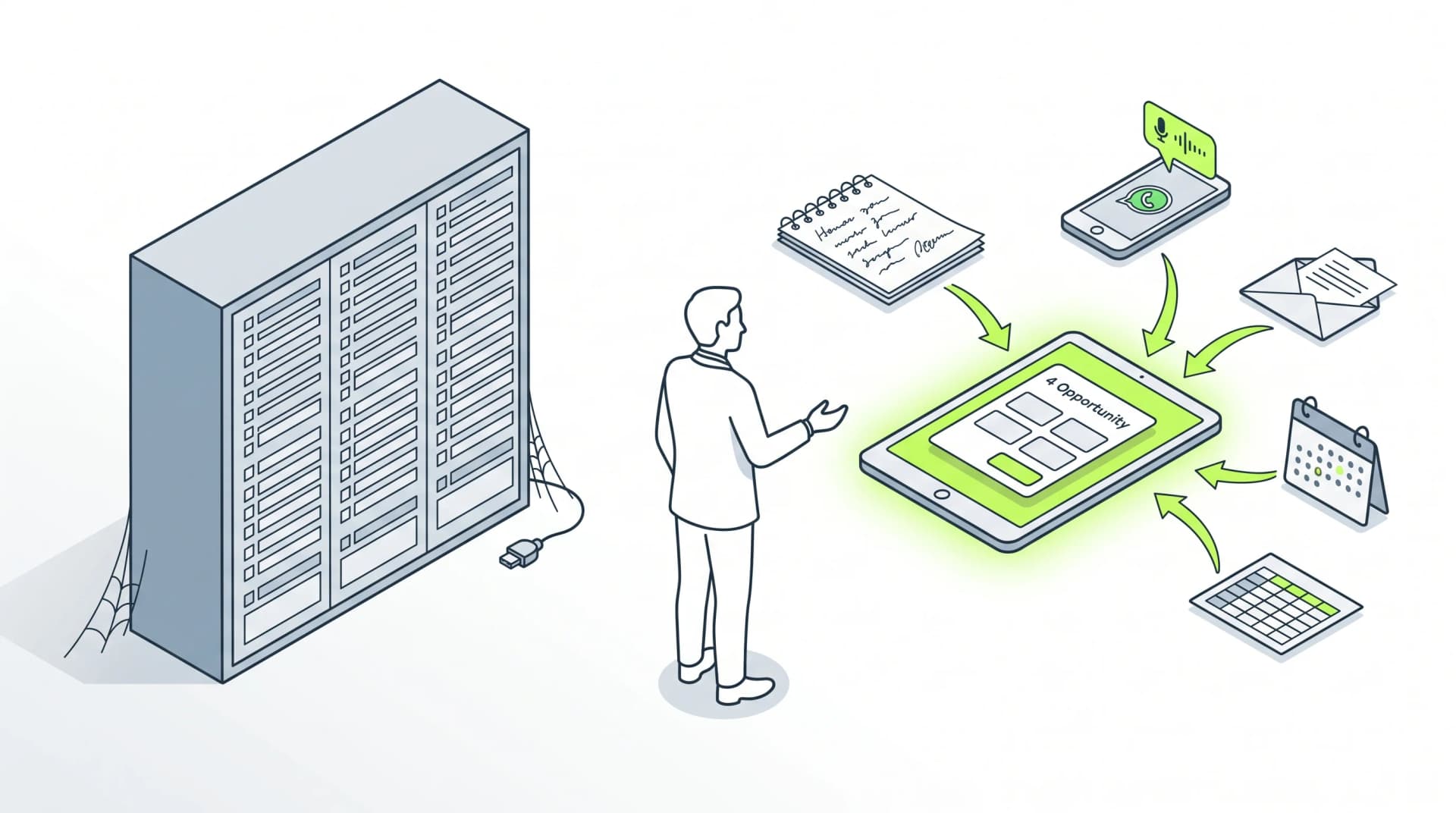
There's a pattern that repeats in almost every company that has rolled out a CRM in the last fifteen years. The sales director asks if it's being used. The official answer is yes. The forecast, however, still comes out of a spreadsheet maintained by one person, and the salespeople still keep their real pipeline in their heads, their inbox and a couple of parallel sheets.
When a 60,000-euro project (or 300,000, depending on company size) turns into a database that only gets updated late on Fridays so it looks green in Monday's report, the industry reflex is always the same: more training, more enforcement, more gamification, tying commission to CRM usage.
That reading is comfortable because it puts the problem on the salesperson. It's wrong. The problem isn't adoption. It's design. And as long as it's treated as an adoption problem, no amount of training will solve it.
The CRM wasn't built for the salesperson
The basic question almost nobody asks when rolling out a CRM is this: who pays the cost of entering the data, and who gets the value?
The salesperson pays. Every lead entered, every call logged, every required field filled in is a minute not spent selling. The value goes elsewhere: the sales director who wants visibility, the marketing lead who wants segmentation, the CFO who wants forecasts, the operations team that wants to coordinate delivery.
It's a pure incentive asymmetry. The person being asked to do the extra work isn't the one receiving the benefit. And the human response to that setup isn't resistance to change. It's rational prioritization.
A salesperson who minimizes the CRM isn't sabotaging the tool. They're doing exactly what they're paid to do: sell. The tool is what gets in the way.
Any attempt to fix this through enforcement (no report, no commission; no update, no visible pipeline) turns a productivity tool into bureaucracy. It works for the first few months. After that, the salesperson fills in the bare minimum to comply, and it becomes clear that the CRM isn't a tool but a control mechanism. Dirty data and eroded trust in parallel.
The single customer record is a useful fiction
The second design error is assuming that all the relevant sales information can live in a single structured record.
The operational reality of a competent salesperson is far more fragmented. The information about an active customer lives across the email history, where the real tone of the relationship sits. WhatsApp and phone calls, where things get closed that never get written down. The salesperson's head, which remembers what happened to the client's cousin last month. A parallel spreadsheet, the one actually used to prep visits. The calendar, which knows the real contact frequency better than the CRM. SharePoint or Drive documents with prior quotes and signed contracts.
The CRM is the seventh place, and the only one that demands manual updating. It isn't the source of truth. It's the post-mortem summary filled in on Friday so there's something to look at on Monday.
That's why CRM data is systematically suspect. Not because the salesperson lies. Because they're reconstructing from memory, days later, what actually happened on other channels.
Dirty data is the symptom, not the disease
When a CRM project hits the one-year mark and the data isn't useful for decision-making, the standard conclusion is that more capture discipline is needed. More required fields. More validation. More auditing.
This makes things worse rather than better. We've seen the same asymmetry over and over in mid-size companies:
| Metric | What the standard CRM asks for | What the salesperson actually needs to sell |
|---|---|---|
| Fields per opportunity | 25-40 required | 4-6 real ones |
| Update frequency | After every interaction | Before the next visit |
| Customer categorization | Industry, size, segment, source, BANT, MEDDIC… | "Buys quickly / negotiates / needs careful handling" |
| Weekly capture time | 4-6 estimated hours | 0 mentally budgeted hours |
| Loss reasons | Mandatory closed taxonomy | "The other guy got there first" |
The reasonable salesperson does the only sensible thing: fills in the minimum, in generic categories (Other, To be confirmed, Undefined), right before the reporting cut-off. The result is a database that's formally complete and operationally useless.
This same pattern is described in another context in our post on the infinite form syndrome: every extra field reduces the aggregate quality of the data. Applied to the CRM, asking for forty fields doesn't produce forty good data points. It produces one good field (the amount) and thirty-nine filled in to comply.
Your sales process is your competitive advantage. The standard CRM asks you to throw it away
This is the part almost nobody is willing to say.
A company that has been selling in its industry for ten, twenty or thirty years has developed its own sales process. It isn't written down in any manual. It lives in how customers get qualified, in what gets promised and what doesn't, in the order of visits, in who decides when to drop the price, in how production gets pulled in when the customer asks for something non-standard.
That process is the real competitive advantage of the company. It's the reason a new salesperson takes eighteen months to perform like a veteran. It's what differentiates that company from its competitors, who sell the same thing to the same customers.
The standard CRM (Salesforce, HubSpot, Dynamics, Pipedrive in their out-of-the-box configurations) assumes a specific sales funnel. Usually the textbook B2B SaaS funnel: lead → MQL → SQL → opportunity → proposal → negotiation → close. That funnel isn't neutral. It's a very specific hypothesis about how selling works, imported from the American enterprise software sales model of 2005-2015.
Adapting your process to that funnel isn't "modernizing". It's giving up your competitive edge in exchange for adopting the same flow your competitors also use. Both of you end up operating with the same theoretical process, the same vocabulary, the same standard KPIs. The veteran salesperson, who knows that's not how selling works in your sector, ends up with two options: lie to fit in (with the dirty-data cost already described), or keep selling their way and fill in the CRM as a chore.
The underlying decision between buying a standard CRM and building one aligned with the real process isn't usually framed correctly. We go into it in detail in Salesforce vs Custom CRM: an honest calculator, but the key point is this: the real cost of a standard CRM isn't the license, or the implementation. It's the silent erosion of the process that made you competitive.
What actually works: software built around the real flow
The alternative isn't "improve adoption". The alternative is to flip the direction.
Instead of asking the salesperson to adapt to the tool, you build the tool around how they actually work. Done right, the salesperson stops "using the CRM" as a separate task and ends up with a system that supports what they were already doing. Some design principles that actually work:
- Low or zero-effort capture. Automatic transcription of voice notes after a visit. Email parsing to detect customer interactions. Two-way calendar sync. The salesperson doesn't enter data: data enters itself based on what they already do.
- Enrichment from systems that already have the data. The CRM shouldn't ask for the customer code, the credit limit, the payment history or the available stock. That's already in the ERP. Asking for it again is the cost of re-keying data.
- Real-business vocabulary and funnel. If in your industry the sales stages are called "sample", "homologation", "pilot order" and "framework contract", that's what the CRM should call them. Not "Discovery", "Proposal" and "Closed Won".
- The director's screen is a consequence, not the goal. Reporting gets generated from what the salesperson needs to see to sell, not the other way around.
For this to work, someone has to sit with the sales team, watch how they actually work for two or three weeks, find where the friction is and build software against that specific friction. That's exactly what a Forward Deployed Engineer does. They don't design in the abstract. They design in presence.
At SAUCO we take this logic one step further. If your company's sales process is your competitive asset, the software supporting it should be too, not a monthly license to the same vendor your competitor uses. We cover the difference between adding a chatbot to your CRM and building real intelligence on top of your operation in our guide on AI applied to customer management.
The problem isn't the salesperson
Worth closing where we opened. When a sales team "doesn't use" a CRM, the comfortable reading is that there's a culture problem, a generational problem, resistance to change. The honest reading is that the tool is asking them to give up the part of the job they do best, in exchange for serving metrics that aren't theirs.
Changing that isn't a change-management problem. It's an engineering problem: building software that respects and amplifies the process that already generates margin, instead of replacing it with a generic one.
If your CRM has spent years "not quite settling in" and the reports still come out of Excel, you probably don't need more training. You need to check whether the tool is designed against your process or for it.
If this sounds like what's happening at your company, book a session with us and we'll look at it in concrete terms.