Salesforce vs custom CRM: the honest calculator
150,000 enterprise customers. Most use under 20% of what they pay for. The decision framework nobody gives you before you sign.
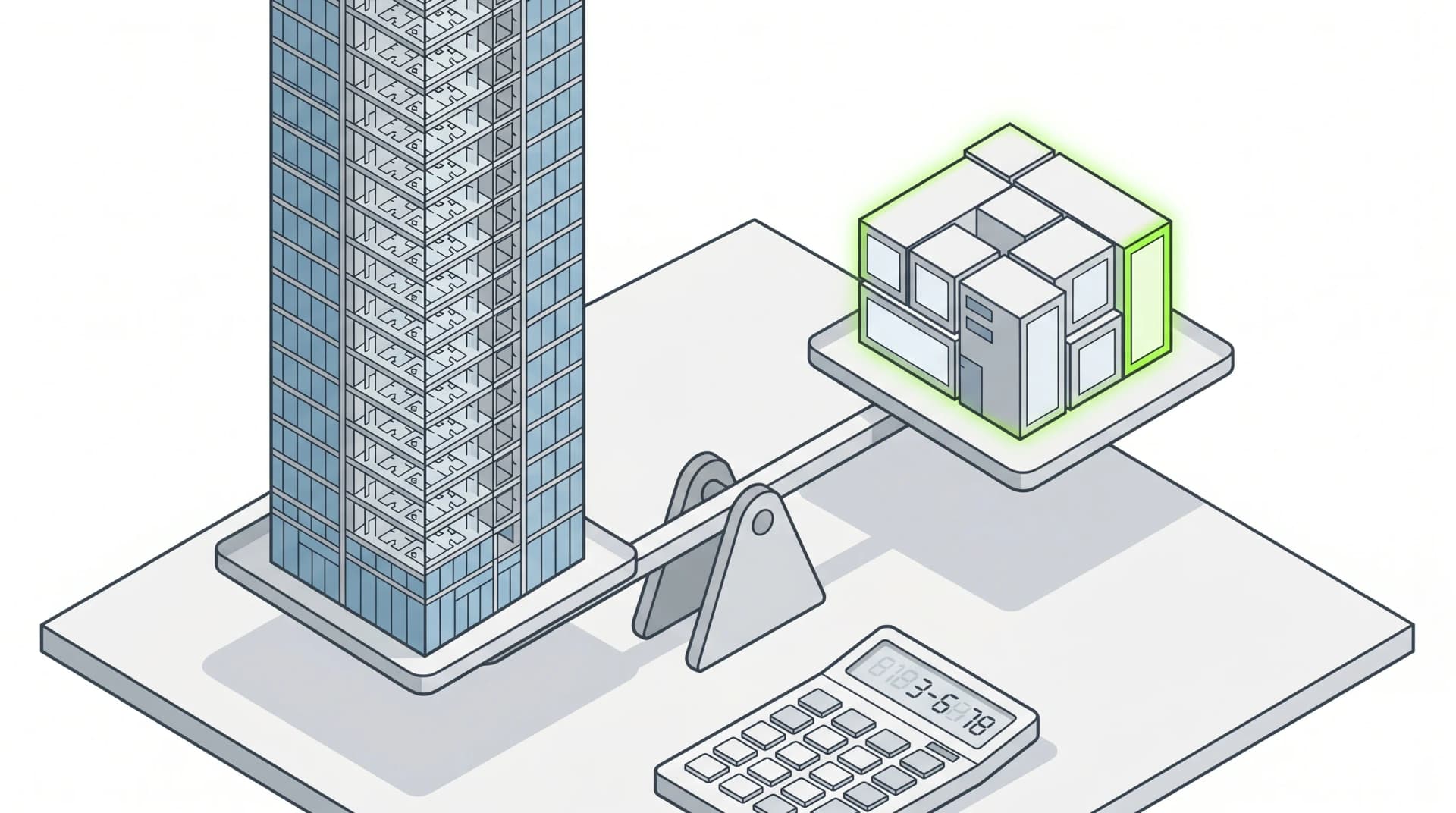
Salesforce has over 150,000 enterprise customers worldwide. Most of them use less than 20% of the features they're paying for.
That's not a knock on the product. It's just the reality of platform adoption. The question isn't whether Salesforce is good — it is, for certain use cases. The question is whether it's the right tool for yours, and whether you've actually done the math.
Most companies haven't.
The license cost is the smallest number
When companies compare Salesforce to a custom CRM, they benchmark license fees. That's the wrong comparison.
The real cost of Salesforce has four components:
- License: €80-150/user/month for Sales Cloud Enterprise. Multiply by your team. The number is visible but rarely questioned.
- Implementation: An average enterprise implementation runs 3-6 months with a consulting partner, at day rates. The TCO figure Salesforce publishes doesn't include this.
- Customization: Every business has processes Salesforce doesn't handle out of the box. Each customization means Apex code, configuration debt, and a dependency on a developer who speaks Salesforce.
- Training and adoption: Salesforce is powerful and complex. Teams don't just start using it. Someone has to build the onboarding, enforce the process, and keep chasing the CRM hygiene.
A 20-person sales team on Sales Cloud Enterprise is looking at €40-60k/year in licenses alone. With implementation and customization, year-one cost lands between €100k and €200k.
The custom CRM comparison needs the same honesty.
When Salesforce is the right answer
Salesforce earns its price when you have three things: scale, complexity, and integration depth.
Scale means your sales operation is genuinely large — 50+ users, multi-region, multiple product lines. At that size, the platform's out-of-the-box workflow, approval flows, and forecasting tools save more time than they cost.
Complexity means your sales cycle is genuinely non-linear. Long enterprise deals with multiple stakeholders, proposal versioning, and multi-stage qualification. Salesforce was designed for this. It shows.
Integration depth means you're running a full GTM stack — marketing automation, SDR tools, support, billing — and you need everything connected. Salesforce's ecosystem is unmatched here.
If you have all three, Salesforce is defensible. If you're missing one, the calculus shifts.
When it becomes overkill
The inflection point is usually around 10-25 users with a sales process that's actually simple.
Simple doesn't mean small. A €5M ARR business with a clear, repeatable sales motion — inbound leads, qualification call, demo, proposal, close — doesn't need a platform built for six-stage enterprise deals with committee approval flows.
What happens in practice: companies buy Salesforce because it's what "serious" companies use. They configure 30% of the features. The rest becomes cognitive overhead — fields nobody fills in, reports nobody reads, dashboards built for a sales org the company doesn't have yet.
And then the customization debt starts. Every time the business changes, someone has to figure out how to express that in Salesforce's data model. Sometimes it's clean. Often it's a workaround inside a workaround.
This is the same pattern from The Shadow ERP: the system becomes the constraint, and the business bends to fit the software.
The custom CRM case
A custom CRM makes sense when your sales process has enough specificity that the platform abstraction creates more friction than it saves.
Specificity might mean: deal structures that Salesforce can't model cleanly. Or a non-standard product catalogue. Or a qualification process deeply tied to proprietary scoring logic. Or a team small enough that the platform overhead isn't worth carrying.
The trade-off is real. Custom software has no out-of-the-box anything. You're starting from first principles on every feature. That costs time and money upfront.
But the comparison isn't "custom vs free." It's "custom vs Salesforce TCO." And when you run that comparison honestly — including implementation, customization, training, and ongoing maintenance of a platform your team doesn't fully control — the gap closes faster than most expect.
As we've laid out in our build vs low-code guide, the question is never whether custom is expensive. It always is. The question is whether the platform alternative is actually cheaper once you account for all the costs it moves off the license line.
The honest decision framework
| Criterion | Salesforce makes sense | Custom makes sense |
|---|---|---|
| Team size | 50+ sales users | Under 30 users |
| Sales process complexity | Multi-stage, multi-stakeholder | Repeatable, well-defined |
| Integration needs | Full GTM stack | Limited integrations |
| Budget (year 1) | €150k+ available | €40-80k range |
| Internal Salesforce expertise | In-house admin or budget for one | None and don't want one |
| Speed to value | Can wait 6 months | Need something working in 8 weeks |
Most companies that come to us with a Salesforce question sit in the middle of this table. Not a clear yes, not a clear no. Twenty sales people, a reasonably complex process, and a TCO nobody has fully calculated.
That's where the conversation actually gets interesting.
What we build and when
At SAUCO, we don't have a default answer to the Salesforce vs custom question. The honest answer depends on the math.
What we do have is a framework for running that math: not just license costs but implementation, customization, adoption, and what happens when the business changes and the CRM has to change with it.
When the numbers point to custom, we build it. When they point to Salesforce, we say so. What we don't do is build a custom CRM for a company that would be better served by a properly implemented Salesforce.
The tool that fits your actual sales process — not the one you'll have in three years — is the one worth buying.
Have this question open? Check our full guide on custom software vs low-code or book a session with our team.