Your client finds out before you do that the project is running late
As a company grows, the status of each project ends up scattered across people, emails and a spreadsheet nobody updates. Why the client is usually the first to see the delay, and what changes when the process itself raises the alarm.
In a lot of project-based companies, the first person to know a project is running late doesn't work for the company. It's the client.
That makes sense when you think about it. The client is the only one who looks at the delivery date every single day, because they're the one waiting for it. Inside the company, everyone looks after their own part, and nobody is looking at the whole project, with all its waits and dependencies.
That gap opens up right when the company starts to grow. It costs money even though it doesn't show up in any account, and it closes once the process itself tells you that something has stalled. Let's take it step by step.
Nobody is lying to you. Everyone knows their own part
You've probably seen this one. A client calls and asks how their project is going, since you told them Friday. You don't know, so you start asking around.
The project manager says their part is done and design is what's left. Design says they've been waiting two weeks for an answer from the client. The same client who just called. Nobody asked for it, because everyone assumed someone else would.
Every answer is true, and that's exactly the problem.
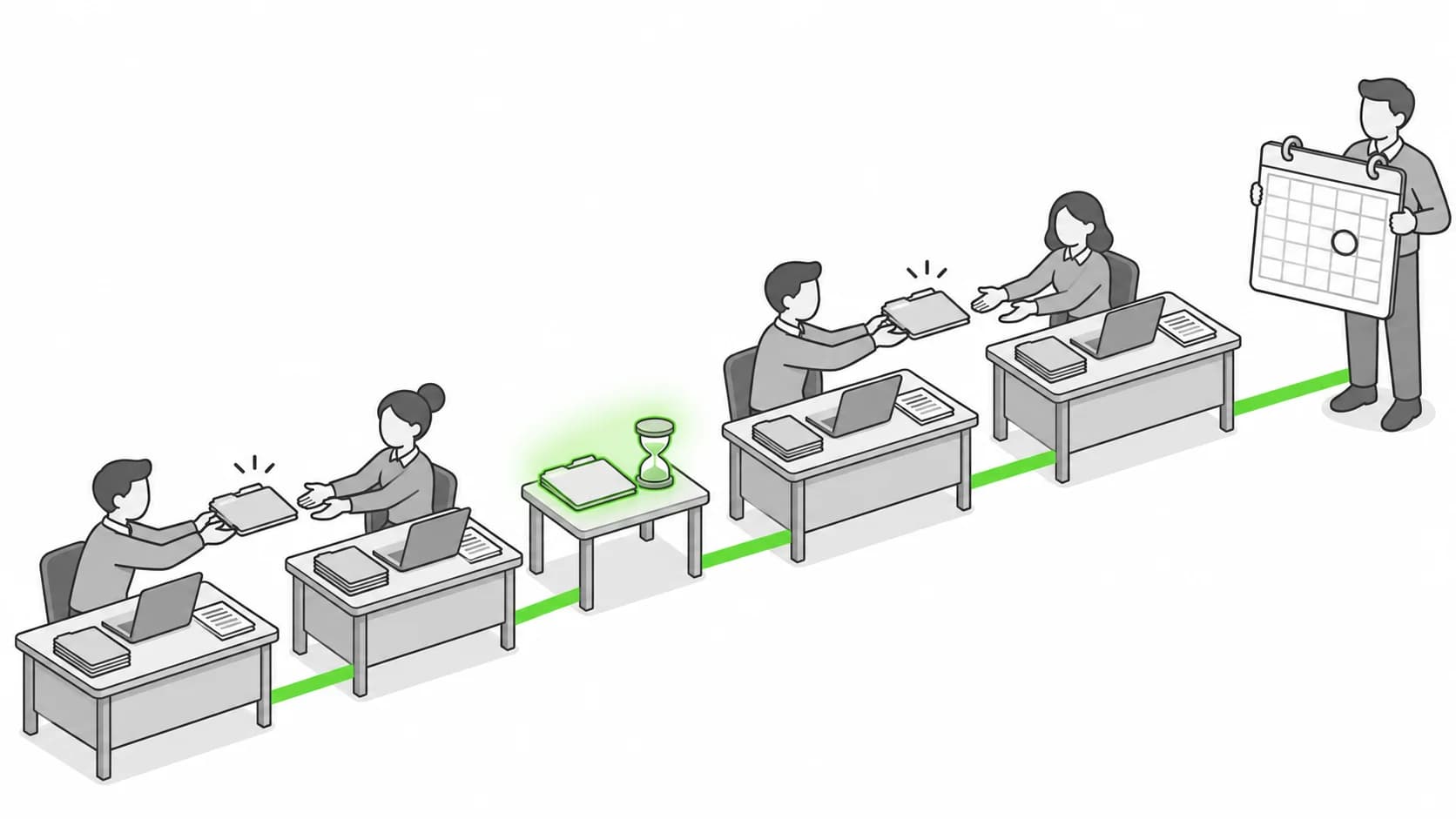
A project looks less like a to-do list and more like a chain of hand-offs between people. What one person finishes is what the next one needs to get started. That's why delays almost never sit inside a task. They sit in the gaps between tasks:
- An answer you're waiting for from the client that nobody has logged as pending.
- A supplier who confirmed a date over the phone and then changed it by email.
- A task that has been "in progress" for three weeks because that person has four other projects on the go.
- An internal review that depends on someone who's on holiday.
None of those gaps has an owner. And what has no owner never raises a flag.
Follow-up arrives late, even when it's done well
The usual response is to tighten follow-up: a weekly meeting, a shared spreadsheet, a progress report every Friday. That's reasonable, and it works up to a point. But it has a limit that has nothing to do with how hard anyone tries.
Follow-up tells you what already happened. The spreadsheet gets updated when someone finds a spare moment, usually after something has changed. The weekly meeting reviews where things stood seven days ago. And the Friday report is put together by someone working from what everyone else tells them, with the same blind spots.
The words we use for status don't help either. "In progress" can mean someone is working on it right now, or that it's been stuck for two weeks waiting on something. "80% done" can stay true for a whole month.
| What the follow-up says | What's actually happening |
|---|---|
| Design: in progress | Waiting on an answer from the client for two weeks |
| Development: 80% done | Blocked by a decision nobody has made |
| Supplier: confirmed | The date changed in an email only one person read |
| Delivery: Friday | Nobody has checked whether Friday is still possible |
Meanwhile, the client knows one thing for certain: nothing arrived on Friday. That's why they find out first.
When there were only a few projects, you held it all together
With five projects open, you barely notice any of this. Whoever runs the company knows every client, knows who's handling what, and hears about delays in the corridor or over coffee. The real follow-up lives in their head, and their head can handle five.
At fifteen, it can't. And the company hasn't done anything wrong to get there. It has grown, which was the whole point. The trouble is that every new project adds conversations, waits and people, while the way it's coordinated is still the one you used when you were smaller.
The cost shows up in places that don't have their own line in the profit and loss account:
- Hours spent chasing. The time project managers and management spend asking how each thing is going instead of moving it forward.
- Deliveries that slip for no reason. Plenty of waits would be solved with one phone call at the right moment. Nobody makes it, because nobody knows it's needed.
- Awkward conversations with clients. Every time the client is the one telling you, you lose a little of their trust, even if the project turns out fine.
- Dependence on whoever runs the company. If everything holds together because someone is on top of it, the company grows only as far as that person can reach. And that person can't take a week off without worrying.
None of this appears in a report, which is why it's so hard to decide to fix it. If you want to put a number on what nobody measures today, we explain how in The cost of doing nothing.
A delay doesn't start on delivery day. It starts the day something stalls and nobody notices.
What changes when the process raises the alarm
Asking the team to update the spreadsheet more often, or adding another meeting, doesn't close the gap. The failure is in how information moves around, and goodwill can't fix that. What works is having the project status keep itself up to date as the work passes from one person to the next.
In practice, putting a project process under control means four things:
- Every task has an owner and a date. That includes the ones that depend on someone outside. If you're missing an answer from the client, that wait is a task too, with someone responsible for chasing it.
- When something stalls, it says so. Nobody has to discover it in a meeting. If a task has gone too long without moving or a date is at risk, the alert goes to the person who needs to move it, and to you if things get complicated.
- Everything is recorded. Who did what and when, what was asked of the client and what they replied. That history helps you understand why a project dragged on, and stops it from happening again on the next one.
- An assistant handles the repetitive work. Reminding someone they have something pending, drafting the progress report from what actually happened that week, writing the email that asks the client for what's missing. The person reviews and decides. Everyone keeps doing their job, with someone telling them what's next.
Here's how the day-to-day changes:
| Situation | Today | With the process under control |
|---|---|---|
| How's the project going? | You ask three people | You look |
| Something is missing from the client | Nobody has it written down | It's a task with an owner and a date |
| A date is at risk | The client tells you | You're alerted before it happens |
| Progress report | Someone fills it in on Friday | It's prepared automatically and you review it |
| Someone goes on holiday | Their part goes dark | Whatever they had pending is visible |
A tracking dashboard is only useful if what it shows is true at the moment you look at it.
None of this means throwing out what you already have. If your team works with email, a management program or spreadsheets, the solution is built around them. What changes is that the process gets organised and stops depending on everyone's memory. As we explain in The island company, tools are rarely what's missing. What's missing is someone connecting what each of them knows.
How we do it at SAUCO, and how we measure what you gain
At SAUCO we put the process your business depends on under control. In a project-based company, that process usually runs from the moment the client says yes to the moment they receive what they asked for.
We always work in the same order:
- We understand how your company works and what it costs you today. Before proposing anything, we take a baseline using indicators you'll recognise: how many projects are delivered late, how often the delay is reported by the client, how many hours go into follow-up.
- We map the process with the real people, waits and exceptions, which don't always match the org chart.
- We mark what moves each step: what has to happen for the next one to start, and who needs to know.
- We build the solution where your team already works, without forcing anyone to switch tools for everything.
- We put assistants on the repetitive work and let it run on its own where it's already safe to.
- We measure what you've gained against the criteria we agreed at the start.
Measurement is part of the work from day one. Before we start, we agree on what gets measured and how, we give an estimate with a range and, at the end, we compare against the baseline. If we can't measure it, we don't promise it.
What you gain is control, because you know how every project is going without having to ask; reliability, because dates are met or you're warned in time that they won't be; and capacity, because you can take on more projects without the meetings and your hours of hands-on supervision growing with them.
Your client will keep calling to ask how their project is going. The difference is that you'll already know.
Shall we talk about your projects? Book a session.