The Hidden Cost of Re-keying: How Much Money You're Losing Copying and Pasting
Copy-pasting between systems doesn't look like a problem. Until you calculate what it costs you each year. The arithmetic is devastating and almost always exceeds the cost of custom software.
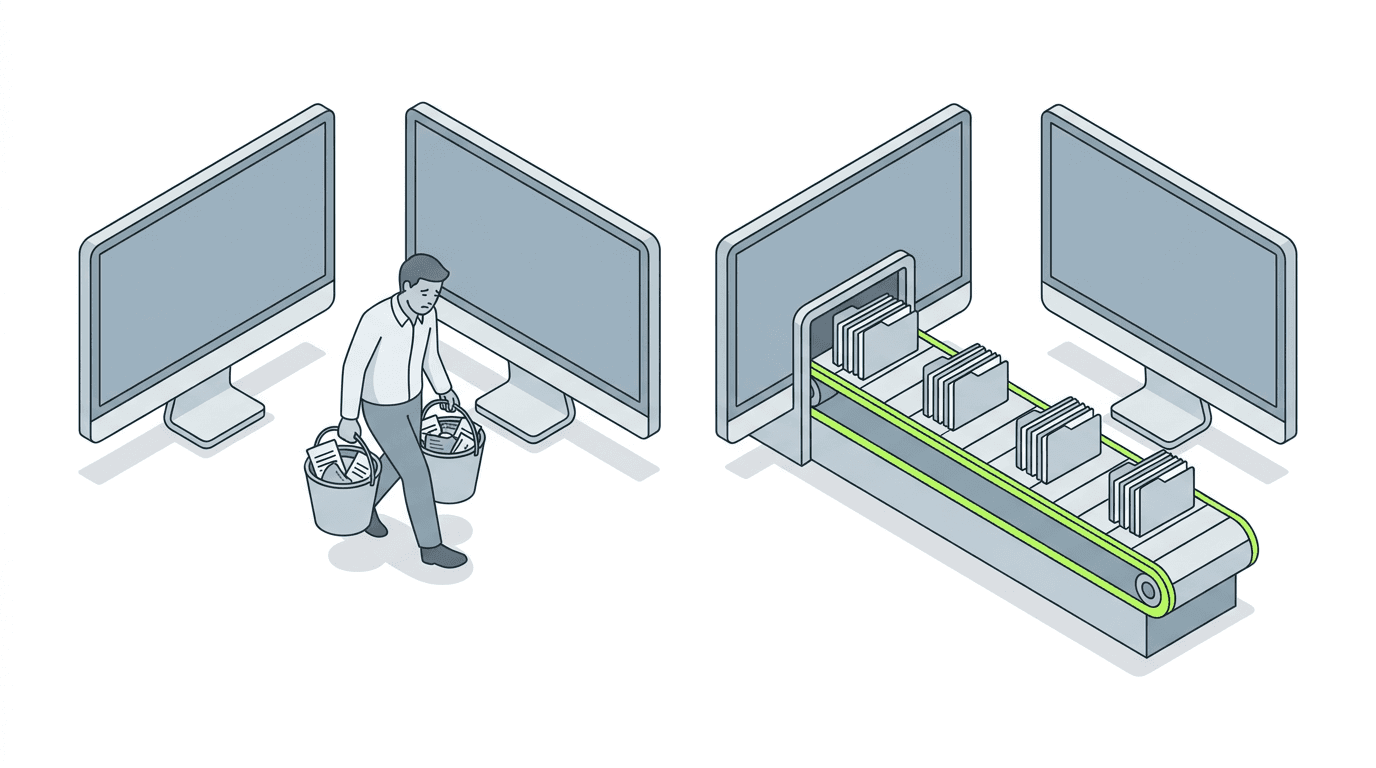
There is a structural cost in almost every company that never appears broken down on the annual balance sheet. It is silent, seems harmless, and worst of all, is completely normalized by the teams who suffer it on a daily basis.
We are talking about the "human bridge" between software systems. The mechanical act of exporting data from one tool, formatting it in a spreadsheet, and re-keying it into a different platform.
Nobody calls it inefficiency. Nobody considers it a financial loss. Inside the company, this organizational hotfix is simply called "the process."
The Accounting Error That Destroys Margins
Most companies have a blind spot in their accounting: the cost of non-integration.
Software licenses appear in the budget (SaaS A, SaaS B, SaaS C). What doesn't appear anywhere is the cost of the friction between them. The time consumed by the human "bridge" between systems is buried in administration or operations salaries, invisible as a normal part of the job.
But that cost exists. And when you calculate it, the result usually triggers an emergency meeting with the CFO.
The Pain Calculator: Real Numbers
The formula is simple. Apply it to your company right now:
Annual Re-keying Cost = Hours/day × Working days × No. of employees × Cost/hour
Mid-size company example (logistics sector, 5 operations staff):
| Variable | Value |
|---|---|
| Daily copy-paste time per person | 1.5 hours |
| Working days per year | 230 |
| People affected | 5 |
| Gross cost per hour (admin/ops) | €22/h |
| Annual total | €37,950/year |
And that's assuming nobody makes mistakes. Because when a pasted data point is wrong, the cost multiplies: reprocessing an order, correcting an invoice, chasing a supplier. Add between 20% and 40% on top for managing downstream errors.
Real estimated cost: between €45,000 and €55,000 per year. Recurring. Every year.
Three Manifestations of the Problem (You Probably Have These)
1. The Bridge Between Your ERP and the Rest of the World
The ERP holds the master orders. The warehouse software manages locations. The carrier system has its own portal. None of them talk natively to each other. Result: someone copies orders from the ERP into the warehouse routing sheet, then manually enters tracking numbers into the customer CRM.
Frequency: Daily. Per employee. Indefinitely.
2. The Manual Management Report
Every Monday, someone extracts data from four different sources (ERP, CRM, treasury spreadsheet, marketing Google Sheets), consolidates it into a PowerPoint presentation, and sends it by 8:00 AM. The process takes two to four hours.
A report that could be generated automatically, in real time, from an integrated dashboard.
Frequency: Weekly. Year after year.
3. The Cascading Price Update
A supplier changes their rates. The purchasing manager updates it in the master spreadsheet. Then in the ERP. Then communicates it to sales to update quotes. Somewhere in the process, someone skips a step, and proposals go out with incorrect margins for two weeks.
Frequency: Monthly. With errors that cost real money.
Why This Doesn't Fix Itself
The most dangerous conceptual mistake is believing "we're managing it already." Yes, you are. With people. But people cost money, make mistakes, go on holiday, and leave the company—taking their process knowledge with them.
The alternative—integrating your systems—isn't an abstract IT project. It's a financial decision.
If the annual cost of the problem is €50,000, and a custom integration costs between €15,000 and €30,000 (recoverable within a single financial year), the right question isn't "can we afford to do it?" but "how much money have we already wasted by not doing it sooner?"
How SAUCO Addresses This
At SAUCO, this is exactly what we do before proposing any technical solution: an operational friction diagnostic.
We sit with the team that executes the processes, not the manager who oversees them. We map the manual bridges, the re-keying, the intermediate files. We quantify them in euros. Then we engineer exactly the integration your company needs—not a generic automation suite, but the specific connections between your specific systems.
The result is an architecture where data travels on its own. The ERP updates the warehouse. The warehouse notifies the carrier. The CRM reflects the shipment status in real time. Your team spends their workday adding real value, not acting as a manual bridge.
That is eliminating friction. That is engineering applied to real business.
Want to calculate how much non-integration is costing your company? Let's talk.