What is a Forward Deployed Engineer (FDE)? The Necessary Evolution of Software Engineering
In the world of technological development, methodologies and roles evolve to adapt to market needs. Discover what an FDE is and why it is redefining engineering.
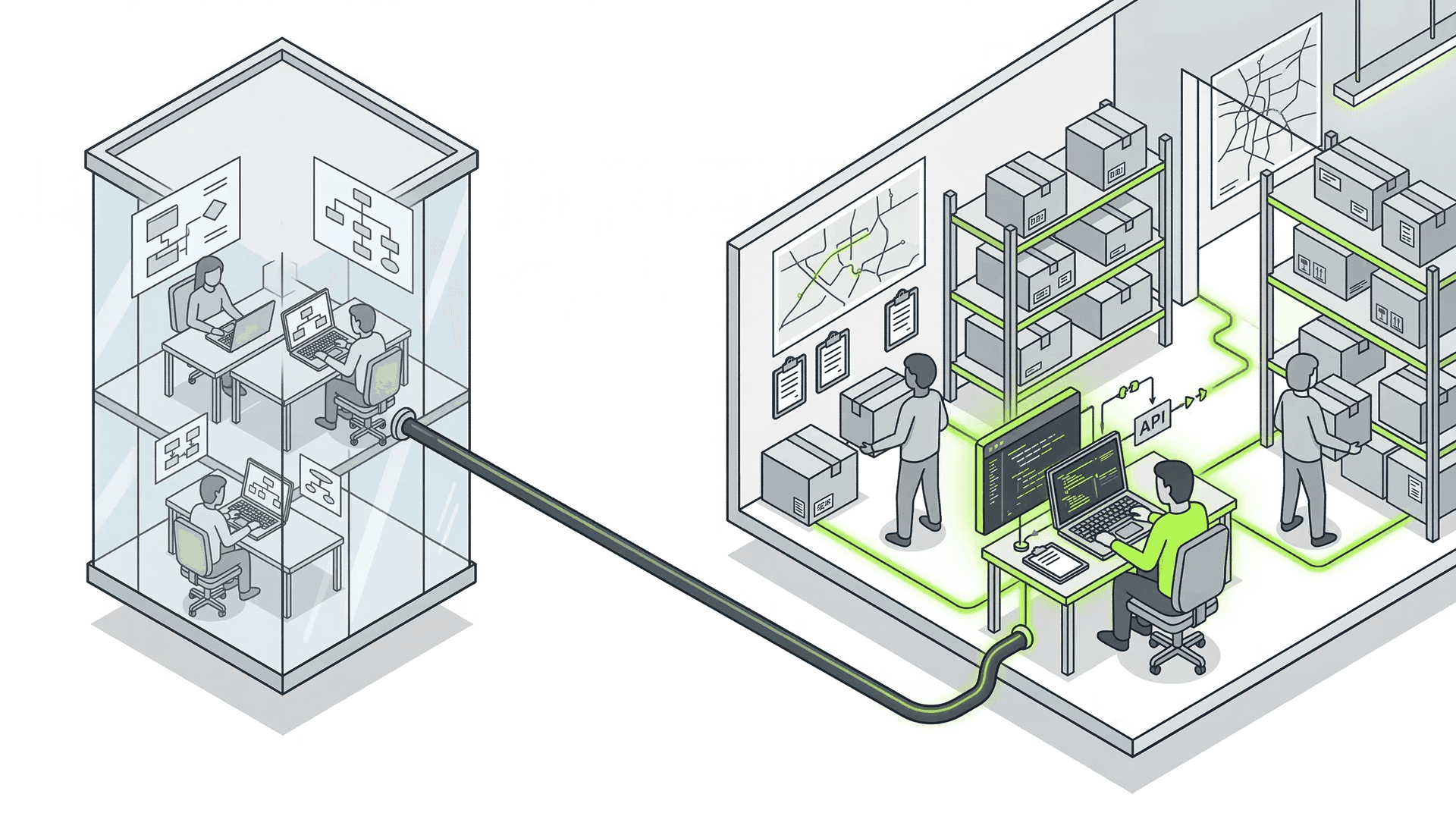
We have moved from the "software factory" model (where specifications are received and code is returned) to easier, more agile models. However, in the last decade, an approach has emerged that is redefining the relationship between engineering and business: Forward Deployed Engineering (FDE).
But what exactly is an FDE, where does this concept come from, and why are leading companies—including SAUCO—adopting it as their main operating model?
Origin: From the Military Trench to the Business Trench
The term "Forward Deployed" has its roots in military jargon. It refers to deploying tactical units directly to the front lines, where the real action happens, rather than keeping them in remote headquarters. This proximity allows for rapid response and real-time adaptation to changing terrain conditions.
Companies like Palantir Technologies were pioneers in applying this philosophy to software development in the early 2000s. Palantir faced the challenge of integrating huge volumes of data in complex environments like government agencies or large financial institutions. They realized that the traditional consulting or SaaS license sales model failed in the "last mile": the actual integration and adoption of the software into the client's daily workflow.
The solution was to send high-level engineers directly to the client's offices. Not as consultants making PowerPoints, but as programmers writing code in the real environment. Thus was born the Forward Deployed Engineer: an engineer who not only knows how to program but "deploys" to the business front to understand its problems from the inside.
What Does an FDE Do? More Than Just Coding
An FDE is a complete software engineer, but their function goes far beyond receiving a ticket and resolving it. Their role is hybrid and strategic:
Operational Immersion
The FDE does not work from a centralized, sterile office. They embed themselves in the client's team—whether in a production plant, a finance department, or a logistics team. Their goal is to understand the "physics of the business": how data actually flows, where manual bottlenecks are, and what problems aren't seen from headquarters.
Translation and Architecture
They act as a living bridge between the business problem and the technical solution. They don't wait for perfect functional specifications; they co-create them with the end user by observing reality. They design the solution architecture based on the constraints and opportunities of the real environment.
Prototyping and Agile Deployment
The FDE seeks to reduce the time between problem identification and value delivery. They prototype solutions directly in the client's context, validate hypotheses quickly, and take responsibility for deployment to production. They don't deliver "software"; they deliver operational results.
Capacity Transfer
The ultimate goal is not to create eternal dependency, but to build robust technological assets (proprietary platforms, automations, AI integrations) that remain as the client's intellectual property and that their team can manage.
Application in Large Companies: Success Stories
The FDE model is no longer exclusive to Palantir. Tech giants and innovative companies have adopted it to solve complex challenges where generalist SaaS falls short:
-
Palantir: As mentioned, this is the canonical example. Their FDEs have been key to implementing their data analysis platform in critical environments, from counter-terrorism to optimizing Airbus's supply chain.
-
FinTech and HealthTech Companies: In highly regulated sectors with sensitive data, an FDE is crucial for navigating compliance complexity and integration with legacy systems, ensuring that new AI or analytics solutions are viable and secure.
-
Salesforce and Other SaaS Giants: Even companies selling software as a service are incorporating similar roles (sometimes called "Solutions Engineers" with a more technical focus) to help their large clients customize and integrate their platforms beyond standard configuration. They realize that client success depends on that final adaptation.
The FDE in SAUCO's DNA: Our Reason for Being
At SAUCO, we don't adopt the FDE model for fashion, but out of conviction. We understand that the democratization of code thanks to generative AI has changed the rules of the game. Today, the bottleneck is no longer writing software, but understanding what software to write to generate real business impact.
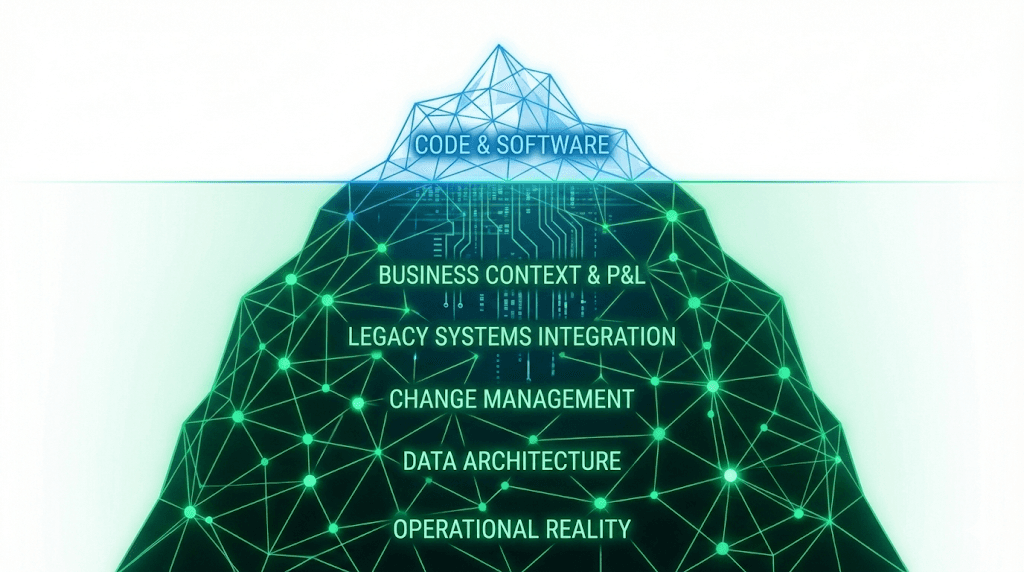 The software iceberg: code vs operational reality
SAUCO's DNA is intrinsically "Forward Deployed":
-
We Prioritize Context Over Code: We believe that a technically perfect solution that doesn't adapt to the client's operational reality is a failure. That's why our engineers start by understanding the business before writing a single line of code.
-
We Embrace Complexity: We don't run from legacy systems, chaotic Excels, or intricate manual processes. We see them as the terrain where the FDE model adds the most value. Our engineers are trained to dive into that complexity and extract clean, robust solutions.
-
We Seek Time-to-Value: Our methodology is not based on pharaonic projects lasting months. By being deployed at the front, our engineers can identify quick wins, prototype solutions, and start generating operational value in weeks, not years.
-
We Take Responsibility for the Result: We are not consultants who give advice and leave. We are engineers who build, deploy, and ensure that the solution works in production and solves the original business problem.
In summary, the Forward Deployed Engineer is not just a technical role; it is a philosophy of how technology should serve business. It is the necessary answer to a world where generalist software is no longer enough to differentiate and where operational complexity requires engineers who think like strategists and act in the trenches.
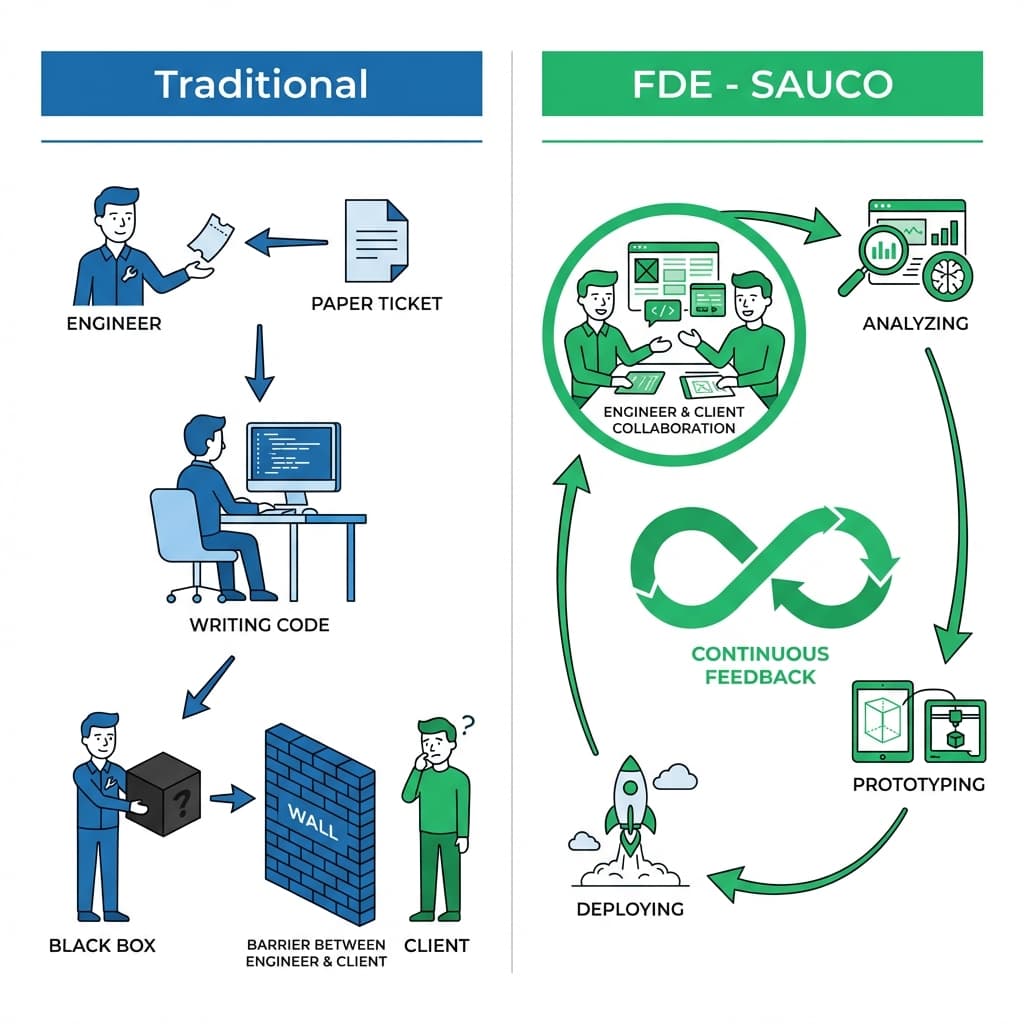 Explanatory Diagram: Traditional vs. FDE
That is the engineer of the future. And that is the engineer you will find at SAUCO.
Want to turn your technology into a real asset? Discover how we work.