RAG for Business: How to Make AI Understand YOUR Business Data (Without Training Models)
Training a custom AI model is slow, expensive, and quickly outdated. RAG (Retrieval-Augmented Generation) is the real-world architecture that lets LLMs use your private data securely and accurately.
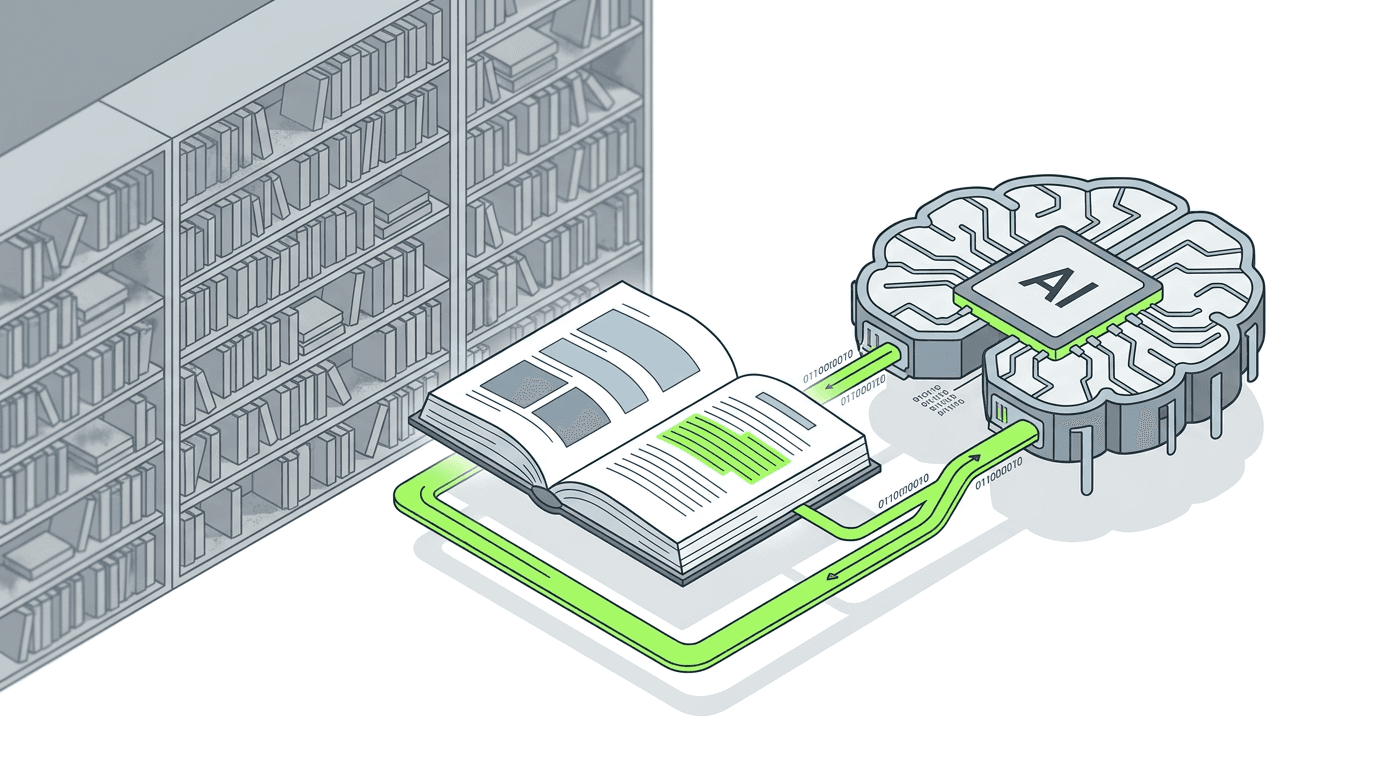
Training your own large language model is, for 99% of companies, a disastrous financial and technical decision. It is slow, prohibitively expensive, and worst of all: the model is outdated the moment it's finished. By the time training ends, your operational data has already changed.
The solution being adopted by companies that actually put AI into production isn't fine-tuning, but RAG (Retrieval-Augmented Generation).
At SAUCO we call it "giving the AI books rather than trying to make it learn them by heart."
The Problem: Memory vs. Retrieval
When you interact with a generic LLM (like GPT-4), you're talking to someone who has read almost the entire internet but has no clue who your best customer is, what your current discount policy is, or exactly what that contract you signed yesterday says.
Attempting to solve this through training (Fine-tuning) presents three insurmountable walls:
- Opacity: You cannot verify where the model gets its information.
- Hallucinations: If it doesn't know something, the model tends to invent it with astonishing confidence.
- Privacy: Sending your master data to train external models is a compliance risk that most CFOs are not willing to take.
What is RAG? The Real-World Architecture
RAG changes the paradigm. Instead of relying on the model's "memory," we provide it with a real-time data retrieval system.
The simplified process works like this:
- Your question: "What is the return procedure for Platinum customers?"
- Search: The system searches your private documents (PDFs, ERP, Database) for the exact fragments that discuss this.
- Context: The system hands the LLM the found fragment and instructs: "Based only on this text, answer the question".
- Answer: The AI responds with real data, citing the source and without inventing anything.
RAG is, essentially, an open-book exam. And in the business world, we prefer someone with an open book over someone trying to remember a sales figure from six months ago.
Three Strategic Business Advantages
1. Verifiable Truth
Every answer generated by a RAG system can include a direct reference to the original document. If the AI says the margin is 12%, you can click and see the report where that figure came from. Trust is the king metric in operations.
2. Instant Updates
If you change a procedure in your operations manual at 10:00, your AI system already knows about the change at 10:01. No re-training. Data flows from your infrastructure to the AI's response without friction.
3. Privacy by Design
Your data never "trains" the global model. It stays within your infrastructure (or your private cloud). The LLM only sees the fragments necessary to answer a specific query and then "forgets" them.
The SAUCO Angle: Context Engineering
Implementing a RAG is not just about connecting a vector database to an OpenAI API. That's a demo, not an operational tool.
At SAUCO, we approach RAG as a Context Engineering problem:
- Data Cleansing: If your documents are a mess, your AI will be a mess. We curate the source.
- Granular Security: We ensure the AI only retrieves information the user has permission to see. An intern should not be able to ask about executive committee salaries, even if the AI "has access" to the documents.
- Proprietary Orchestration: We design the workflows that decide when to use AI and when to query the ERP directly for exact figures.
AI should not be an experimental toy. It should be the system that allows your team to stop searching for information and start making decisions with it.
Does your company have a mountain of data that no one consults? Let's talk about how to make your AI understand it.