Logistics 2026: Why Sticking with Excel Is Competitive Suicide
Last-mile delivery costs represent up to 53% of total logistics spend. In most mid-sized companies, that last mile is managed from a spreadsheet nobody designed and three different people edit simultaneously.
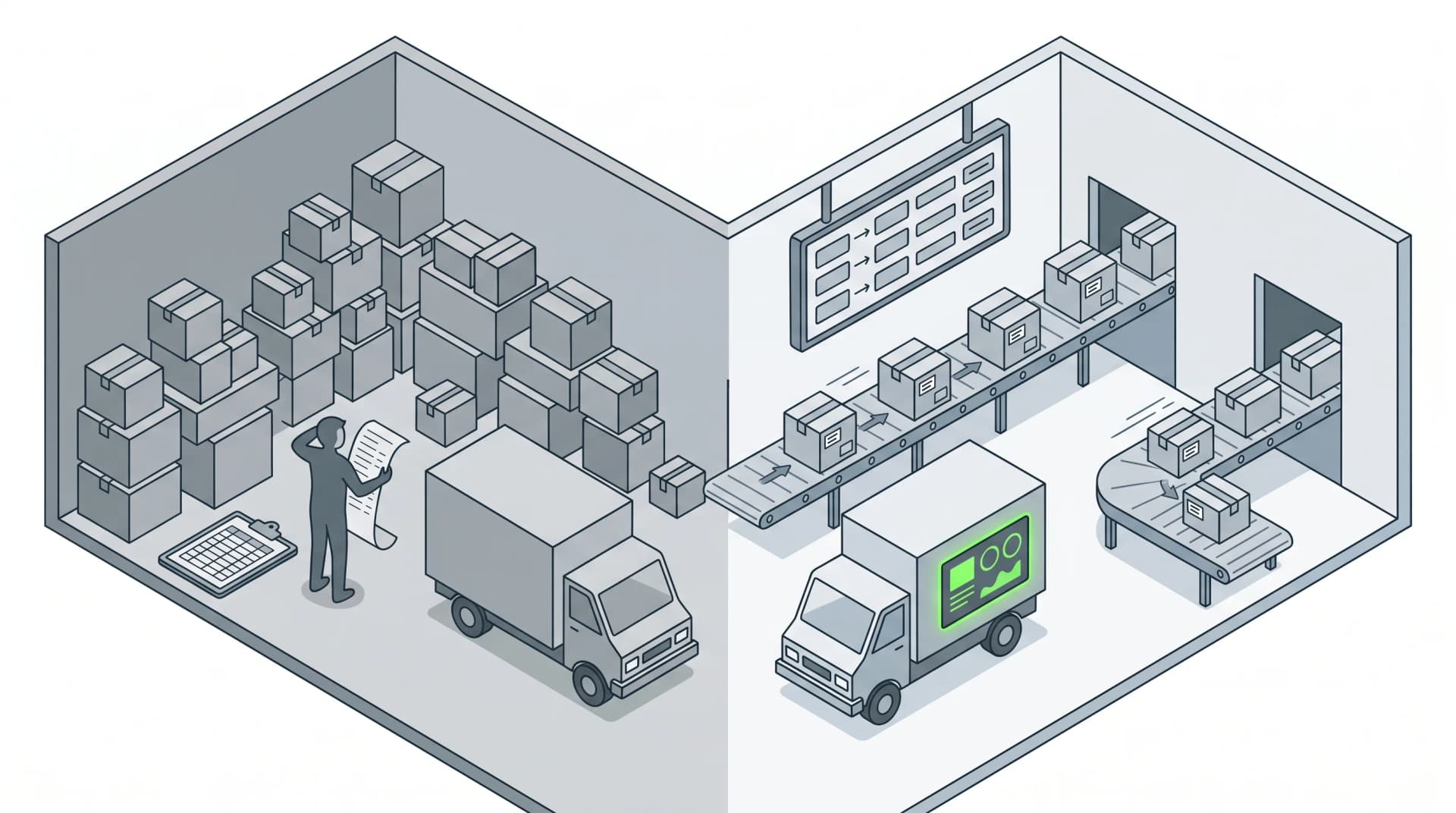
Last-mile delivery costs represent between 41% and 53% of total logistics spend. In most mid-sized distribution companies, that last mile is managed from a spreadsheet nobody designed and three different people edit simultaneously.
That was acceptable when customers had patience. In 2026, they don't.
The mid-market logistics stack
It's not one spreadsheet. It's six.
One for warehouse stock, updated when someone remembers. Another for the day's routes, which the fleet manager prints every morning. A sheet for delivery failures, sometimes. A file with carrier rates and terms, last updated fourteen months ago. And an order backlog table that lives in two people's email simultaneously, with different versions.
On top of this stack, someone has to make real-time decisions: which order goes out first, which route optimizes the truck, how to handle a carrier failure at 8am.
That person does it from memory. And they do it well, until they can't.
Where it breaks
The volume spike
Demand peaks — sales, Black Friday, product launches — multiply volume 2 or 3x. The spreadsheet doesn't scale. The brain running it doesn't either.
What happens: mixed orders, mis-assigned routes, delivery commitments that can't be kept, and a customer service team managing the resulting chaos with the same spreadsheet, now at double speed.
The unplanned return
E-commerce return rates run 20-30% in fashion and electronics. In a manual system, every return is manual work in reverse: reinstate stock, cancel the route, process the refund, notify the customer.
In an operation processing 200 orders a day at a 25% return rate, that's 50 manual processes daily. Each with its own chance for error, its own delay, and its own invisible cost.
The promised delivery window
The 2026 customer doesn't accept "between Monday and Wednesday." They accept "tomorrow before 2pm" or they go elsewhere. That promise requires real-time data: where's the vehicle, what capacity does it have, how long is the route.
With spreadsheets, the promise is made on intuition. Kept by luck. And when it fails, 73% of customers don't buy again.
The real cost of the manual stack
| Process | Manual system | With integration |
|---|---|---|
| Order processing | 8-12 min/order | <1 min/order |
| Route assignment | Manual, 45 min/day | Automated |
| Returns handling | 15-20 min/return | <3 min/return |
| Incident detection | Reactive (customer calls) | Proactive (automatic alert) |
| Picking error rate | 1-3% | <0.3% |
| Cost per failed delivery | 2-3x original delivery cost | 60-80% reduction |
For a company processing 150 orders daily, the move from manual to integrated recovers 15-25 hours of work per week. And an incident rate that stops growing proportionally with volume.
As we've covered in The Hidden Cost of Re-keying Data, every manual handoff between systems is a margin leak that shows up in no cost report.
What connected logistics actually needs
Not a generic WMS. Generic WMS systems solve 60% of the problem and create their own friction with the rest of the stack.
A mid-market logistics operation needs to connect four layers:
- Real-time stock: the warehouse knows exactly what's there and where. Not "approximately" or "as of yesterday's close."
- Route planning with real data: traffic, vehicle capacity, customer delivery windows, access restrictions. Together, at the moment of assignment.
- Customer visibility without manual work: the customer gets automatic updates. The support team doesn't have to search three systems to answer "where's my order?"
- Integrated exception management: when something fails — a broken-down vehicle, a wrong address, an absent customer — the system routes the exception and triggers the right response without anyone having to coordinate it manually.
None of these four layers is rocket science. The problem is that each one sits in a different tool, with different data, and none of them talk to each other.
As we described in The Shadow ERP, the spreadsheet stack exists precisely because no single system covered the whole case. Each tool solved a part. Spreadsheets solved the rest.
Why now
The margin for logistics inefficiency has compressed nearly to zero.
In 2019, the e-commerce customer tolerated 4-5 day delivery and a 5-8% incident rate. In 2026, the baseline expectation is 24-48 hours and tolerance for incidents is zero: any failure generates a public review before the support team has opened the ticket.
The competitor that has solved its logistics doesn't just deliver faster. They deliver with fewer errors, handle returns without friction, and have performance data by route, carrier, and zone that lets them make better decisions next week. Your company is still updating the shared spreadsheet.
The advantage isn't technological. It's operational. And it compounds.
What we build at SAUCO
At SAUCO, we work with distribution and e-commerce companies that have hit the ceiling of what their manual stack can hold.
We don't implement a generic WMS that handles 60% of the case. We build the specific integration for their operation: their carriers, their warehouses, their prioritization rules, their delivery SLAs by channel.
The result isn't just speed. It's visibility: knowing at every moment what's in the warehouse, what went out, what failed, and what it will cost if volume grows 40% next quarter.
What is your current logistics stack actually costing you? Check our guide on eliminating Excel dependency in operations or book a session with our team.