Legacy Modernization: How to Kill the Giant Without Stopping Operations
Migrating old systems is scary. Discover how to replace your monolithic software module by module without stopping billing, using the Strangler Fig Pattern.
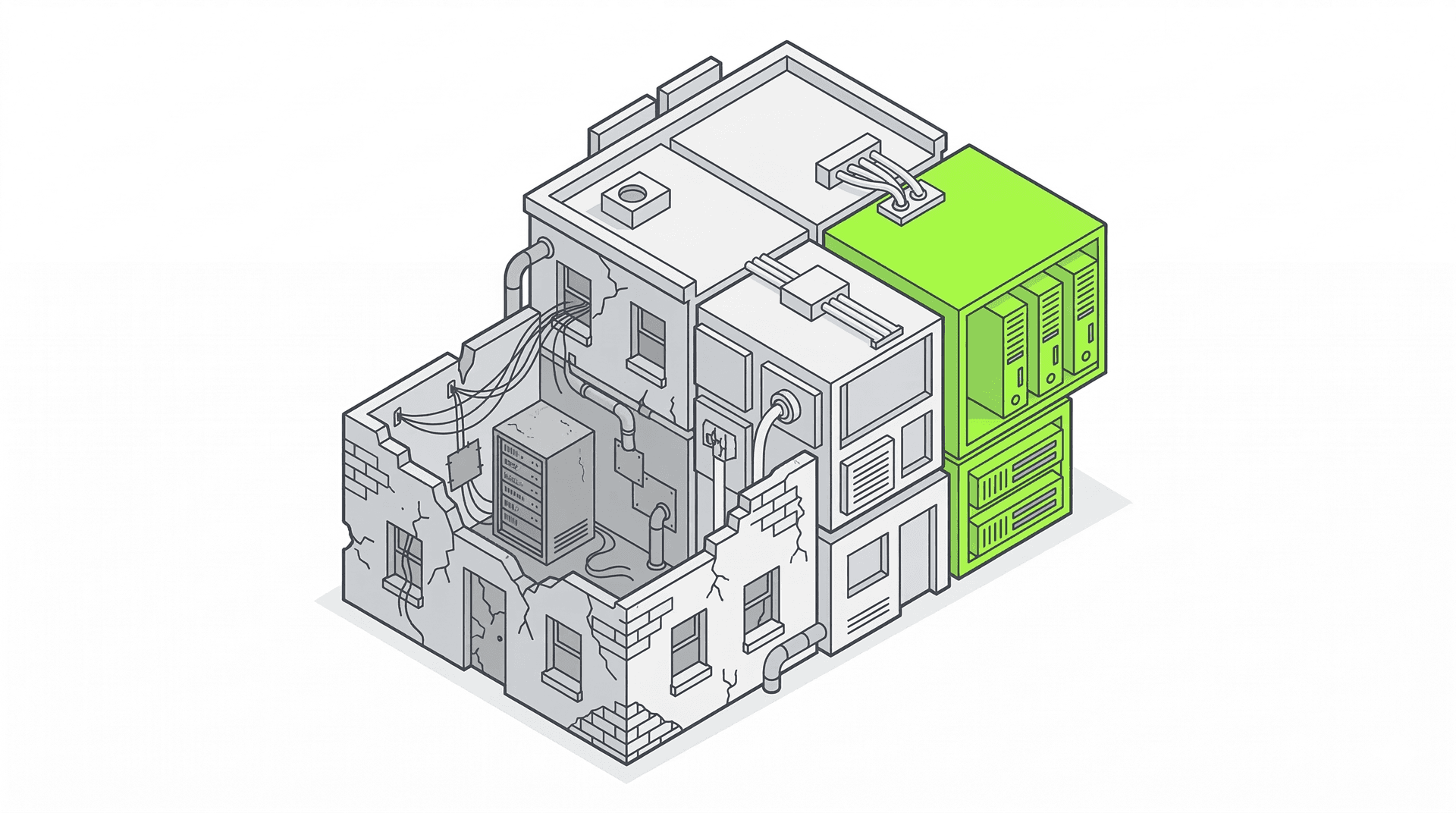
There is a scene that repeats itself in boardrooms across the country. The CTO, with three-day dark circles under their eyes, puts up a slide with an unintelligible diagram of boxes and arrows and says: "We have to rewrite everything from scratch. The current system can't take it anymore."
The CEO, remembering that the last time they tried that they lost six months of revenue and two million euros, responds with a resounding "No way."
And they are both right.
The Legacy system (that 15-year-old monolith written in a version of Java that is no longer supported) is an anchor that prevents innovation. But attempting a total rewrite ("Big Bang") is a suicide mission. Software history is littered with the corpses of companies that tried to rewrite their Core from scratch and died trying.
You cannot stop the factory to change the engine. You have to change the engine while the car is running.
The "Big Bang" Fallacy
Every engineer's fantasy is to throw the old code in the trash and start a greenfield project with the latest technologies. "This time we'll do it right," they tell themselves.
It's a trap.
- Old code has value: Those "hacks" you see in the code (nested ifs, weird exceptions) are often fixes to real business problems that happened 7 years ago. If you delete the code, you delete the knowledge.
- The moving target: While your team spends 18 months rewriting the old system, the business keeps asking for new features. By the time you finish "Version 2.0", it will already be obsolete regarding current needs.
- Analysis paralysis: Fear of breaking something paralyzes value delivery.
The Solution: The Strangler Fig Pattern
In nature, the strangler fig (Ficus aurea) is born in the branches of a host tree. It sends roots down to the ground, gradually enveloping the original tree. Over time, the original tree dies and rots away, leaving the fig in its place, with the same shape but completely new and strong.
In software engineering, Martin Fowler adapted this as the Strangler Fig Pattern.
The strategy is simple: Don't touch the monolith. Surround it.
Step 1: The Anti-Corruption Layer
The first thing we do at SAUCO is not touch the old code. It's putting a "door" in front of it. An API or Proxy that intercepts all requests.
The rest of the world (your web, your app, your clients) stops talking directly to the Legacy Giant and starts talking to our Interception Layer. At first, this layer does nothing more than pass the request to the old system. But we already have traffic control.
Step 2: Strangle Module by Module
We identify a small, isolated functionality. For example: "PDF Invoice Generation".
Instead of fighting with code from 2010, we write a new, modern microservice in the cloud that does just that: generate perfect invoices.
Then, we configure our Interception Layer: "When someone asks to 'Create Invoice', don't call the Giant. Call the new microservice."
The user notices nothing. Operations don't stop. But you just killed 1% of the Giant.
Step 3: Repeat Until Extinction
Repeat the process. User Management. Inventory. Shipping.
Gradually, traffic flows to the new modern systems. The old monolith receives fewer and fewer requests. It dries up.
One day, you look at the logs and see that the Legacy system is no longer doing anything important. That day, you turn it off. No fireworks. No panic weekends. You simply disconnect the server.
Operating Open Heart
This methodology requires a different mindset. We are not architects who design blueprints and leave. We are surgeons operating open heart.
At SAUCO, our Forward Deployed Engineers specialize in this high-precision surgery:
- Coexistence: We make the new and the old speak the same language during the transition.
- Automatic Fallback: If the new microservice fails, we automatically redirect to the old system. Zero operational risk.
- Real-Time Data: We keep the old database synchronized until the very last second.
Don't let the fear of breaking the system force you to keep it broken forever. Modernization is not a leap into the void; it is a controlled, gradual, and safe engineering process.
The Giant must die. But your company must continue to live.
Do you have an untouchable system slowing down your growth? Let's talk about how to surround it.