The Infinite Requirements Meeting: The Antipattern That Kills Projects
Analysis paralysis kills more projects than imperfect execution. How to recognize the infinite requirements loop and break out before it's too late.
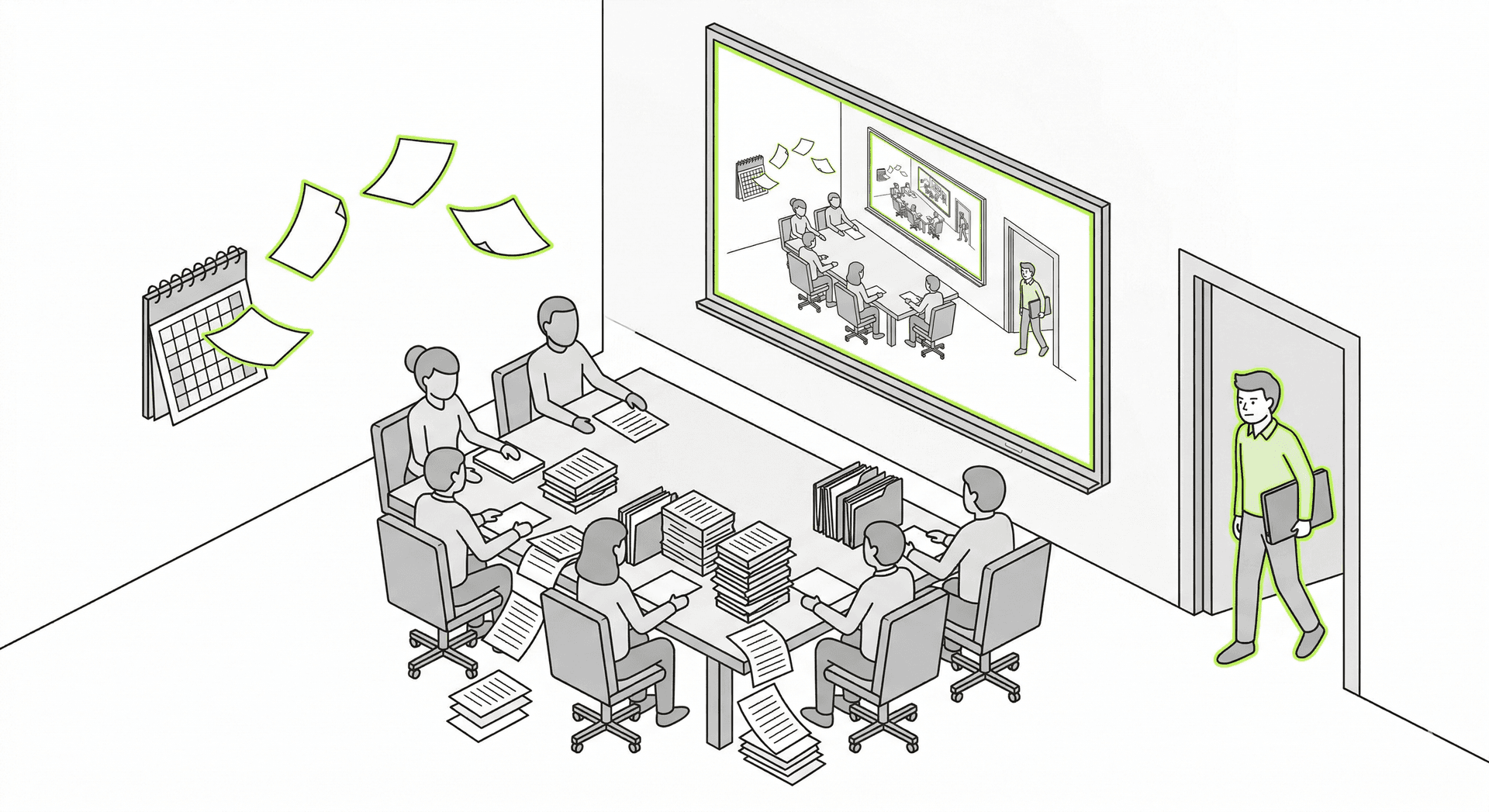
Requirements gathering as a comfort zone
Some teams have been documenting requirements for six months. They have a 140-page document, four flowcharts, and an impeccable traceability matrix. What they don't have is software.
It's a pattern that repeats with alarming frequency. A project starts with good intentions — "this time we'll do it right, we'll define everything before writing a single line of code" — and ends up trapped in an infinite loop of meetings, validations, and scope reviews. The Standish Group has been measuring this for decades: projects with exhaustive specifications don't have better success rates than those that start with a well-defined minimum scope. In fact, they often do worse.
The meeting that spawns more meetings
The first sign you're in the antipattern is when every requirements meeting ends with "we need another meeting." Someone raises an edge case. Another discovers that the current process has an exception nobody documented. The product owner wants to validate with a third department.
None of this is irrational in isolation. The problem is that it becomes the default operating mode. Requirements gathering stops being a means and becomes the end. The team feels like it's making progress because it produces documents and meeting minutes. But the distance between the first meeting and the first line of code keeps growing.
Why it happens: the psychological cost of deciding
Analysis paralysis is not a methodology problem. It's an incentives and risk aversion problem. Documenting requirements is a safe activity: nobody can blame you for "being thorough." But making a design decision, writing code that might be wrong, deploying something a real user will touch — that carries personal cost.
In large organizations, this bias amplifies. Every stakeholder wants "their" use case reflected in the specification because they know that once development begins, there'll be less room for changes. So the requirements phase becomes a political battle disguised as a technical exercise.
The result is a document that tries to predict the future. And documents don't predict the future.
The hidden cost of the perfect specification
While the team perfects the specification, the business context shifts. Maybe a competitor launches a similar feature, or the department that requested the project reorganizes and now has different priorities. Every month of delay doesn't just consume budget — it erodes the relevance of what you're defining.
There's a phenomenon that engineers at SAUCO call "zombie requirements": specifications that were relevant when written but no longer reflect operational reality. Nobody removes them. They accumulate in the document like geological layers, adding complexity to something that doesn't exist yet.
The real cost isn't just the time spent in meetings. It's the lost opportunity to learn something by building. A two-week prototype generates more useful information than three months of stakeholder interviews.
When to stop and start building
This isn't about eliminating requirements gathering. It's about knowing when you have enough to start. A heuristic that works well in practice: if you have 70% certainty about what needs to be built, start. You'll discover the remaining 30% during execution, not in a conference room.
This isn't improvisation. It's recognizing that certain types of knowledge only emerge when a real user interacts with a real system. You can document for months how an approval flow should work, or you can build a basic version, put it in front of the person who'll use it, and watch what happens.
The difference between "actually agile" and "PowerPoint agile" lies exactly here. Teams that truly iterate accept the discomfort of deploying something incomplete. Those that don't disguise their risk aversion with agile ceremonies while continuing to pile up requirements in a backlog that nobody trims.
The FDE model: deployed engineering against paralysis
At SAUCO, we don't start from a 140-page requirements document. We start from a concrete operational problem and an engineer embedded in the team experiencing it.
The Forward Deployed Engineer model works because it eliminates the translation layer between "what the business needs" and "what the technical team understands." When the engineer sits next to the person executing the process, requirements are captured by observing, not by asking. Validation comes from building something and seeing if it works, not from adding another page to the document.
This changes the dynamic completely. Instead of months of preliminary meetings, the cycle is short: observe the actual process for a few days, build a first functional version in two to three weeks, put it in production, and adjust based on what happens. Requirements emerge from use, not from speculation.
Documentation has value, but as a record of decisions made — not as a prior contract for what needs to be built. The most useful documentation is written after the software works, not before.
How to tell if you're already trapped
If you've spent more than a month defining requirements without building anything, the risk is real. A specification document that exceeds 50 pages and keeps growing is another clear signal. And when every meeting ends with "we need to involve another department," the loop has already closed on itself.
The way out is not to abandon planning. It's to accept that the plan will change and that the best way to refine it is to have something built that tests it.
Is your project stuck in definition phase? Book a session with our team and we'll help you identify what to build first to unblock progress.