The Infinite Form Syndrome: Why Your Employees Hate Your ERP
Companies spend millions on customer experience but ignore that their employees use interfaces from the 90s. Every unnecessary field is friction. Every extra click is money lost.
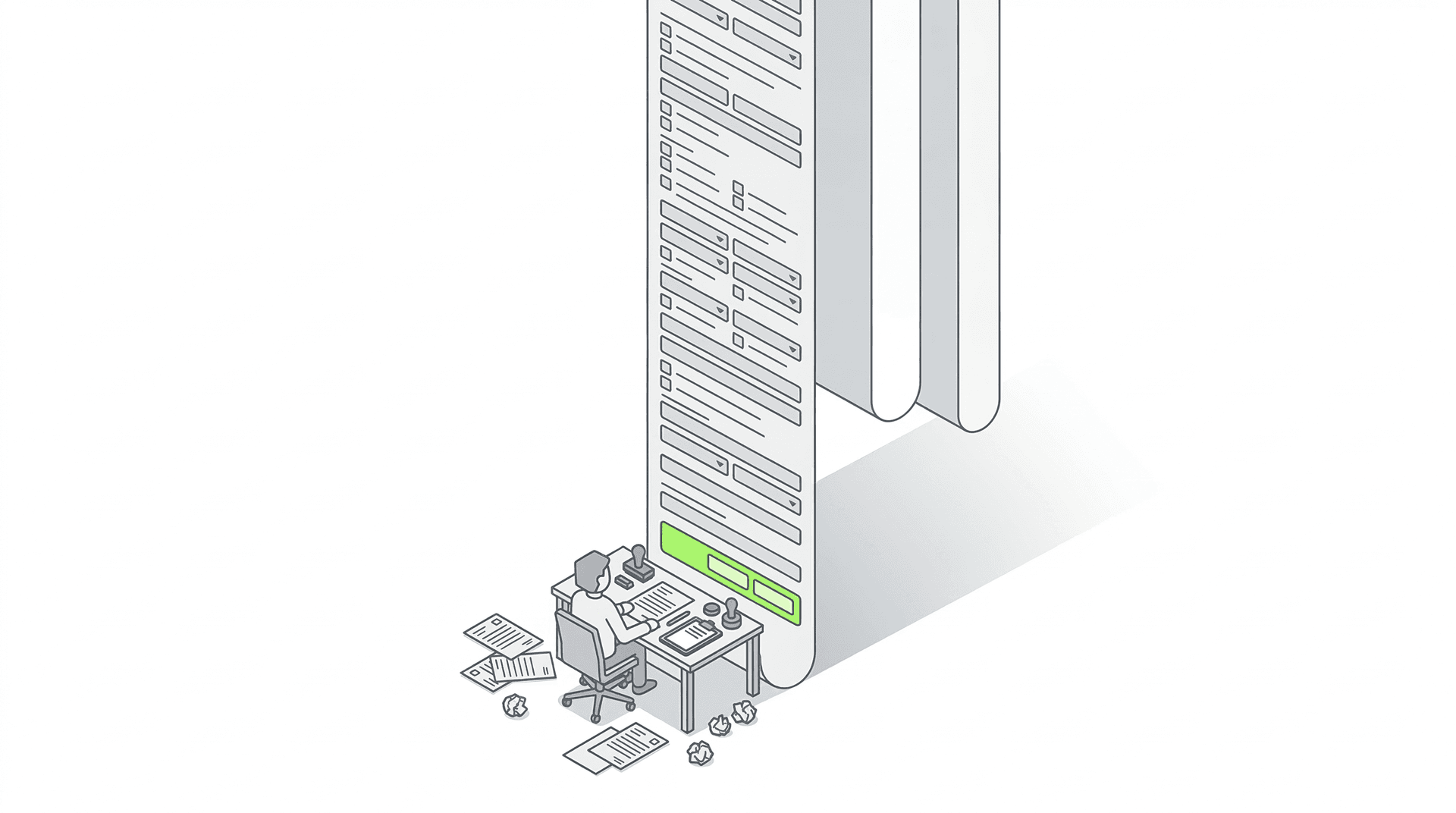
It's 9:15 AM. María, operations manager at a distribution company, opens the ERP to log a delivery incident. Three screens, 47 mandatory fields, and 12 clicks later, she still hasn't finished. The phone rings. An angry customer. María minimizes the form —unsaved, again— and takes the call.
This ritual repeats 30 times a day. Multiplied by 15 people on the team. Multiplied by 220 working days a year. That's 99,000 annual interruptions caused by software that's supposed to help.
Welcome to the Infinite Form Syndrome.
The Problem Nobody Wants to See
Companies invest fortunes in Customer Experience (CX). They hire consultants, redesign websites, optimize conversion funnels down to the last pixel. But when they turn inward, toward their own employees, standards change radically.
Internal software —ERPs, CRMs, ticketing tools— looks like it was designed in 1998 and barely modified since. Gray interfaces, infinitely nested menus, fields nobody knows the purpose of but that are "mandatory by configuration."
The irony is brutal: we treat anonymous website visitors better than the person who's been creating value for the company for 10 years.
The 3 Invisible Costs of Bad Internal UX
1. Lost Time (The Direct Cost)
Every unnecessary field, every extra click, every confirmation screen that adds nothing is time. And your team's time has an hourly cost.
Let's run conservative numbers:
- 5 extra minutes per task due to bad UX
- 20 daily tasks per employee
- 15 employees in operations
- Average cost/hour: €25
5 min × 20 tasks × 15 people = 1,500 min/day = 25 hours/day
25 hours × €25 × 220 days = €137,500/year
€137,500 annually evaporated in clicks that shouldn't exist. And this is just one department.
2. Errors and Rework (The Indirect Cost)
When a form has 50 fields, the probability of error skyrockets. And each error generates:
- Detection time
- Correction time
- Possible downstream consequences (incorrect billing, wrong shipments, angry customers)
Industrial usability studies show that each additional unnecessary field increases the error rate by 2-5%. A 50-field form can have error rates of 20% or more.
3. Turnover and Burnout (The Hidden Cost)
This one never appears in reports, but it's the most devastating.
Nobody resigns saying "I'm leaving because the ERP is horrible." But accumulated daily friction —the frustration of fighting with tools that don't work, of feeling ignored by a company that demands efficiency but provides last-century tools— erodes morale.
The cost of replacing a qualified employee ranges from 50% to 200% of their annual salary. How many quiet resignations has your internal software caused?
Why This Happens: The "That's How It Comes Configured" Trap
Generalist ERPs (SAP, Oracle, Dynamics, Sage) are powerful. They can do almost anything. But that flexibility has a price: they come configured for the generic case, not for your specific operations.
And here's the trap:
- Initial implementation: The integrator configures "the standard" to finish on time and within budget.
- "Just in case" fields: Nobody wants to be responsible for removing a field that "might be used someday." Result: bloated forms.
- Fear of touching: Once in production, modifying the ERP interface is scary. "What if we break something?" Better not touch it.
- Resigned users: Over time, the team assumes "that's how it works" and stops complaining.
The result is software that technically works but operationally tortures.
The Solution: UX Engineering for Internal Tools
At SAUCO, we apply the same design principles that the best consumer apps —Notion, Linear, Figma— use to our clients' internal tools.
It's not about making the ERP "prettier." It's about experience engineering:
1. Real Friction Audit
We sit with actual users (not the IT Manager, but whoever uses the tool 8 hours a day). We observe. We time. We identify specific pain points:
- What fields are always filled the same way? → Default values.
- What fields are never used? → Elimination or move to secondary tab.
- What information could be auto-completed? → Integration with other systems.
2. Parallel Interfaces (Without Touching the Core)
We know touching the ERP is scary (and sometimes contractually impossible). That's why we build custom interface layers that talk to the ERP underneath but offer a radically simplified experience.
The user sees 7 fields. The ERP receives the 47 it needs (auto-filled, calculated, inferred).
3. Mobile-First for Field Operations
If your warehouse team or field technicians use the same ERP as the finance department, you have a problem. You're giving them a hammer when they need a scalpel.
We design role-specific mobile apps, connected to the corporate backend but optimized for the reality of each position.
4. Real Productivity Metrics
We implement real usage tracking: time per task, clicks per operation, form abandonment rate. Hard data to prove the redesign ROI and continue optimizing.
The ROI of Treating Your Team Well
Let's go back to the numbers from the beginning. If investing in internal UX:
- Reduces time per task by 60% (from 5 extra minutes to 2)
- Reduces errors by 50%
- Improves retention by 10%
The return on a €50,000 redesign investment can be 3-5x in the first year. And the benefit compounds every year while the team continues using tools they don't hate.
But beyond the numbers, there's something more important: showing your team that their time matters. That the company asking for excellence provides excellent tools.
That can't be quantified. But you feel it in every meeting, every interaction, the difference between a team that survives and a team that pushes.
Conclusion: Internal Software Is Corporate Culture
Every form you require sends a message. Every unnecessary click says something about your priorities. The software you give your team is your corporate culture made code.
What message does your current ERP send?
At SAUCO, we believe your employees deserve tools as well-designed as those you offer your customers. Not because it's trendy or pretty, but because it's good business engineering.
Is your team losing hours fighting infinite forms? Let's talk about how to simplify it.