Garbage In, Garbage Out: Why Your AI Project Failed Before It Started
80% of AI projects fail before production. It’s not the model’s fault, nor the hardware. It’s the lack of 'Data Readiness'. Discover the hierarchy of needs no one tells you about.
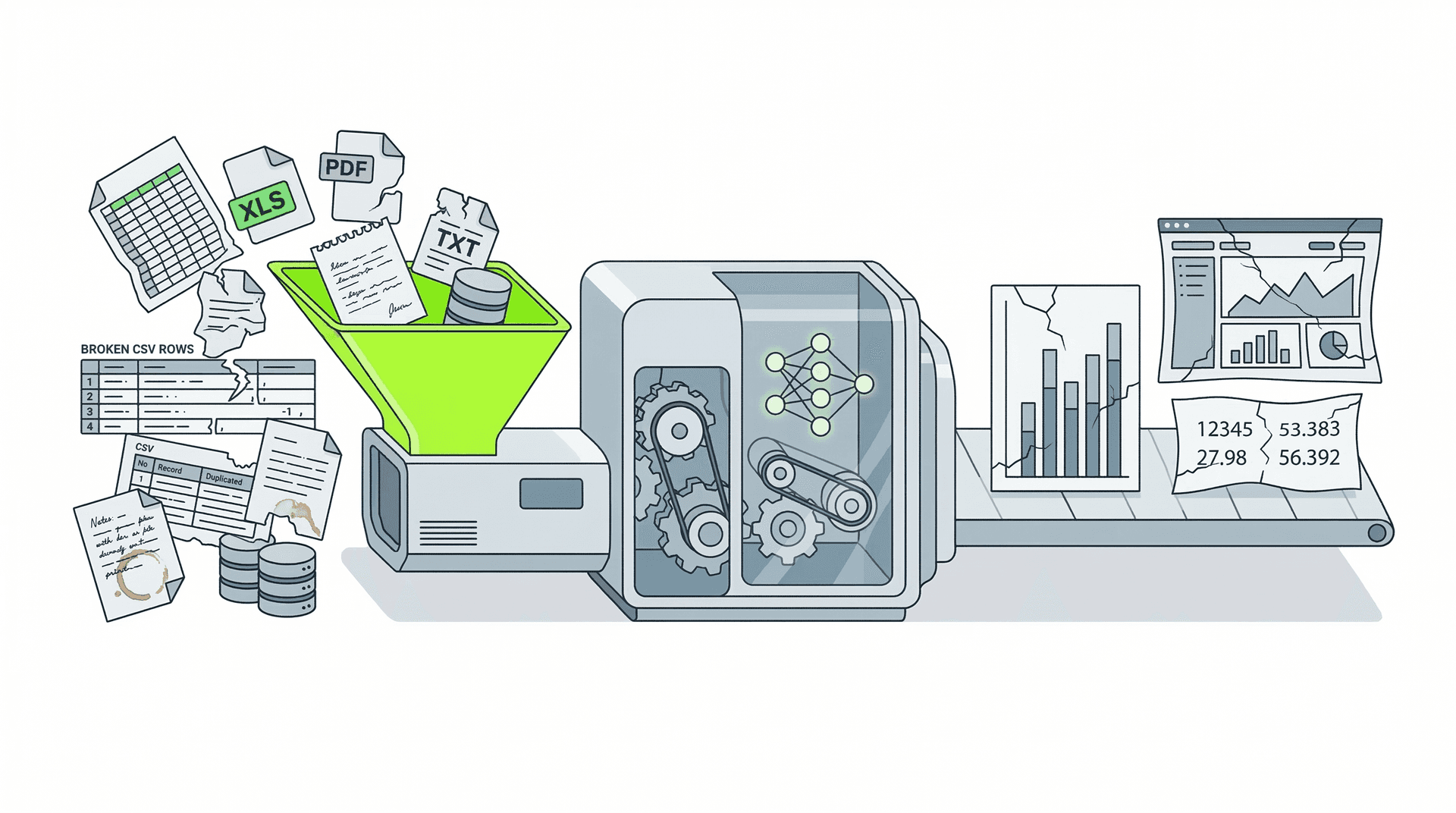
It’s 9:00 AM on Monday. The Board of Directors is waiting for the demo of the new "AI Sales Predictive System". It's been six months of development, external consultancy hirings, and a licensing invoice that induces vertigo.
The CTO connects the screen. Everything looks futuristic. He enters a simple query to validate the project's ROI: "What is the safety stock forecast for reference X-500 for the Christmas campaign?"
The AI, connected to a state-of-the-art LLM and your ERP, processes, "thinks", and answers with aplomb: "Based on 2023 history, it is recommended to reduce stock to zero, as reference X-500 had no sales activity".
The Operations Director turns pale. "Zero? X-500 is our best-seller. The thing is, in 2023 we changed its code to Y-500 during the SAP migration, and then back to the original in 2024".
Silence. The AI didn't know that. No one told it. For the model, X-500 and Y-500 are two distinct universes.
Result: A recommendation that, if executed automatically, would have cost millions in stockouts. The project is paused indefinitely. The CEO sentences: "AI is not ready".
But the AI worked perfectly. It was your data that lied.
The "Big Data" Lie
Over the last decade, companies became obsessed with hoarding data. "Data is the new oil," they said. They stored everything: logs, transactions, Excels, emails. They created gigantic Data Lakes.
The problem is that, without context and structure, a Data Lake quickly turns into a Data Swamp.
Having petabytes of information does not mean having knowledge. If your sales data lives in a CRM, your inventory data in an old ERP, and the "real truth" of operations lives on post-it notes from the plant manager or in a local Excel file called PRODUCTION_FINAL_VFINAL_REAL.xlsx, your company is not machine-readable.
The AI Hierarchy of Needs
Before running, you must walk. At SAUCO, we visualize AI as the peak of a pyramid of needs, similar to Maslow's:
- Collection (The base): Do you have the data? Is it accessible?
- Flow: Does it move reliably and automatically between systems? (ETL/ELT).
- Exploration and Cleaning: Is it normalized? Do we know what's missing?
- Aggregation and Labeling: Does it have semantic meaning? Is it connected?
- AI / Machine Learning (The peak): Prediction and automation.
Most companies try to jump from step 1 to 5. They buy the OpenAI API and connect it to a dirty database. This violates the fundamental principle of computing: Garbage In, Garbage Out (GIGO).
If garbage enters (incoherent, duplicated, biased data), garbage comes out (hallucinations, erroneous predictions). And the worst part: garbage comes out with the appearance of truth, which is far more dangerous than an obvious error.
The 80% Invisible Work
The industry sells the "magic" of the algorithm. But any senior data engineer will tell you the uncomfortable truth:
80% of an AI project's success is Data Engineering. Only 20% is the model itself.
Preparing your data for AI (Data Readiness) implies:
- Entity Resolution: Understanding that "Telefónica", "Tfos", and "Client 892" are the same entity.
- Context Capture: Digitizing tribal knowledge. Why did sales drop in May? "Ah, because there was a transport strike". If that data is not digitized, the AI will learn false patterns (e.g., "sales drop in May just because").
- Governance: Who can see what and what is the "source of truth".
FDE: Reverse Engineering Reality
At SAUCO we don't start by installing models. We start by putting on our boots and getting down in the mud.
Our Forward Deployed Engineering (FDE) approach is radically different:
- Mapping Physical Operations: We first understand the real process. How does a box move? Who signs the delivery note?
- Building the Ontology: We create a digital model that reflects how YOUR business works, not how the software says it should work. We connect the dots between ERP, CRM, and reality.
- Data Hygiene at Source: We implement systems so that data is born clean. Real-time validations, interfaces that prevent human error.
Only when the foundations are reinforced concrete do we build the Artificial Intelligence skyscraper.
Conclusion: Stop Buying Magic
AI is not a magic wand that fixes broken processes. It is an amplifier.
- Amplifying efficient processes and clean data -> Exponential Scalability.
- Amplifying chaos and dirty data -> Exponential Chaos.
The next time you are pitched an AI project, don't ask what model they will use. Ask how they will guarantee that your data tells the truth.
Are you ready to stop playing the lottery with your data? Let's talk serious engineering.