Event-Driven Architecture: Why Your System Should React, Not Ask
Move from constant polling saturation to event efficiency. Discover how an Event-Driven Architecture (EDA) offers real scalability and faster response times.
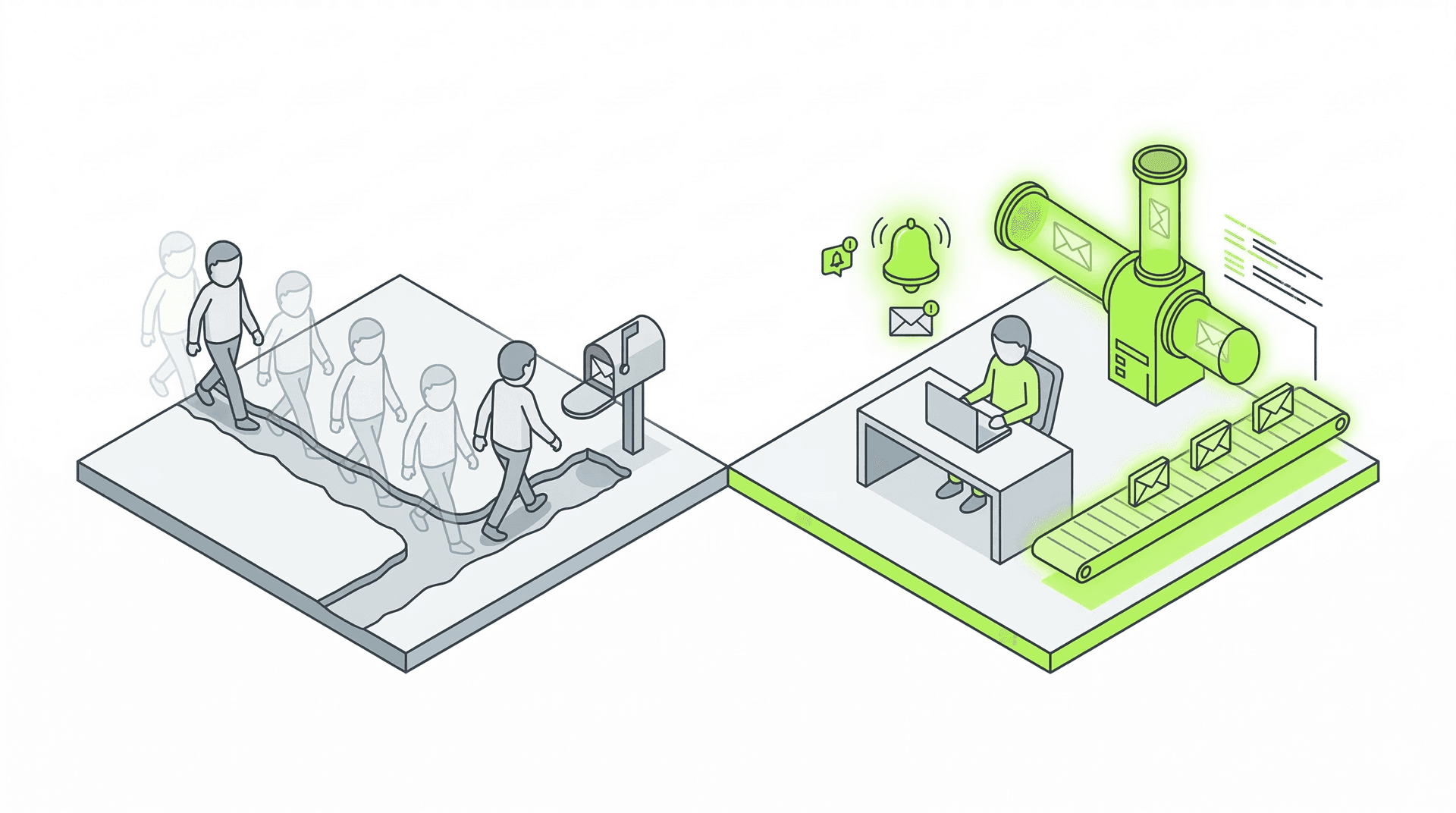
Imagine you're waiting for an important package. You have two options to know if it has arrived.
The first is to call the delivery company every five minutes: "Has it arrived yet? How about now? And now?". This wastes your time and clogs up the company's phone line. The second option is for the company to send you a message (an event) the exact moment the package is at your door.
In software development, the first option is called Polling. The second is Event-Driven Architecture (EDA). And the difference between the two isn't just a technical detail; it's the difference between a system that collapses under pressure and one that scales effortlessly.
The Problem with Constant Polling
Historically, many systems have been built using a Request-Response paradigm. If Service A needs to know if Service B has finished a task, it simply asks. If it hasn't finished, it waits and asks again.
This Polling approach makes sense in small systems, but at scale, it becomes a lethal bottleneck:
- Wasted Resources: 90% of the time Service A asks, the answer is "Not yet." CPU cycles, memory, and network bandwidth are consumed in useless conversations.
- Induced Latency: If you poll every 60 seconds, and the event occurs one second after you ask, you delay the response by 59 seconds.
- Tight Coupling: Service A needs to know exactly who Service B is, where it is, and how to talk to it. If B fails, A fails too.
In short, you are paying for infrastructure (cloud or physical) so your servers can constantly ask each other if there's anything new to do, instead of doing the actual work.
The Solution: Reacting to Events
In an Event-Driven Architecture (EDA), system components don't ask each other questions. They communicate by publishing and subscribing to events. An event is simply an immutable record that something has happened: "User registered", "Payment completed", "Sensor activated".
When something happens in the system:
- The component performing the action (Producer) fires an Event to a centralized channel (like a message bus or event broker such as Apache Kafka, RabbitMQ, or AWS EventBridge).
- The Producer doesn't need to know who else is listening. It simply notifies the system that something happened.
- Any service that needs to know about that action (Consumer) is subscribed to that type of event and reacts instantly.
Radical Advantages for Your Business
We are not just talking about writing "prettier" code. We are talking about technical decisions that directly impact the viability of the product.
- Real and Elastic Scalability: If you suddenly experience a massive spike in user sign-ups (Black Friday, product launch), the system doesn't collapse asking the database if everything is saved yet. Events are queued, and services process them at their own pace.
- Resilience (Isolated Failure): If the service sending welcome emails goes down, the main user registration system keeps working. The "User registered" event is safely stored in the broker, and when the email service comes back online, it picks up exactly where it left off. Zero data loss.
- Agility to Add New Business Rules: Does the Marketing team want to start sending an SMS when a user registers? You don't have to touch the registration service code. You simply create a new microservice that subscribes to the "User registered" event and sends the SMS.
Technical Decision = Financial Decision
Implementing EDA requires a mindset shift. It is initially more complex to design and requires more sophisticated observability tools because the execution flow is no longer a predictable straight line of API calls, but an asynchronous system.
However, the Return on Investment (ROI) is overwhelming when you reach a certain scale. You stop paying for idle cloud servers, reduce system downtime during critical moments, and radically improve Time-to-Market for new features.
The SAUCO Angle: Building for Change
At SAUCO, we understand that software architecture isn't about using the latest tech trend; it's about designing systems that support your business growth without drowning it in infrastructure costs.
Our Product Engineering approach evaluates your real operational load to decide if you need an agile monolith, microservices, or an event-driven architecture. We design platforms that react to market opportunities in real-time, ensuring your software is an engine of acceleration, not an anchor of heavy processes.
Let your system react. Let your team move forward.