The Cost of Doing Nothing: Calculating the Status Quo
Operational inertia isn't free. Every month you spend not solving a problem has a computable cost that nobody calculates. Here are the numbers missing from your budget.
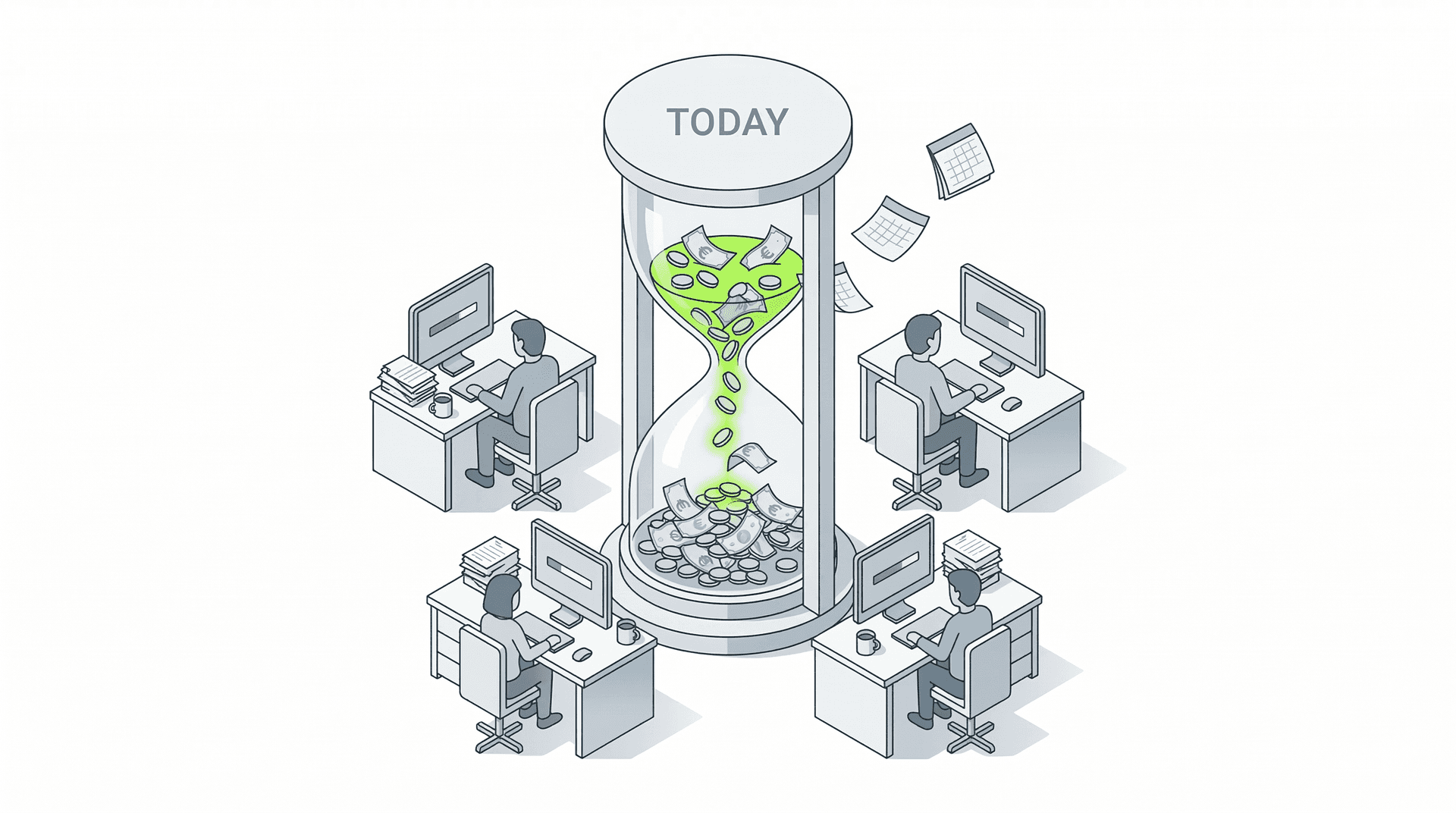
Companies budget for change. They request proposals, compare vendors, calculate depreciation schedules, and debate in committee whether it's worth investing 40,000 euros in a software project. It's a rational, orderly, well-documented process.
What nobody budgets for is the alternative: doing nothing.
There's no line in the finance spreadsheet that says "cost of staying as we are." There's no budget line for inertia. And yet, inertia has a price that gets paid every month, quietly, spread across salaries, errors, missed opportunities, and hours that nobody logs as waste.
The decision not to decide is, financially, the most expensive of all. It's just that nobody sees it because it doesn't come with an invoice.
The illusion of zero cost
When a management team decides to postpone a project, the perception is that "we're not spending anything." The budget stays intact. Nobody signs a purchase order. On the income statement, the technology investment line reads zero.
But that perception is an accounting trap. The cost exists. It's buried elsewhere.
It's in the 12 hours a week that Carmen from accounting spends consolidating data from three different systems into a master spreadsheet. In the two orders that got duplicated this month because the warehouse and sales teams work with unsynchronized information. In the client who didn't renew because it took you four days to send a quote that should have gone out in four minutes.
None of these costs are labeled "operational inefficiency." They show up as payroll, as returns, as churn. They dissolve into the P&L and nobody connects them to the decision not to act.
How to calculate what it costs you every month
The formula isn't complicated. What's complicated is getting someone to sit down and do it.
You need to identify the specific problem and break it down into three cost categories.
The first is direct time. Hours that real people spend on tasks that could be automated or eliminated. Multiply hours by gross hourly cost. Multiply by 12 months. The number always stings.
The second is derived errors. Every manual process generates errors. Every error generates rework: correcting invoices, resending orders, calling suppliers, apologizing to clients. Estimate the monthly frequency of errors and the average resolution time. Multiply.
And then there's opportunity cost, which is the hardest to quantify and the largest. The business you don't close because your team is busy putting out fires. The expansion you don't execute because you lack operational visibility. The talent you lose because nobody wants to work at a company where 30% of the day is copying data from one place to another.
A real example. Professional services firm, 25 people. Problem: project management runs on a combination of Excel, email, and human memory. There's no visibility into project profitability until close-out.
| Category | Calculation | Annual cost |
|---|---|---|
| Time on manual reporting | 3 people × 6h/week × 48 weeks × €28/h | €24,192 |
| Billing errors | 4 incorrect invoices/month × 2h correction × €35/h × 12 | €3,360 |
| Projects with negative margin detected too late | 2 projects/year × €8,000 avg loss | €16,000 |
| Turnover of one burned-out project manager | 1 departure/year × replacement cost | ~€12,000 |
| Estimated total | ~€55,500/year |
Over 55,000 euros per year. Recurring. Cumulative. And completely invisible in the budget because it's spread across payroll, eroded margins, and a turnover KPI that "we'll improve next year."
The status quo bias
There's a psychological reason why organizations tolerate absurd costs for years without acting. It's called status quo bias, and it's been documented in economic theory since Samuelson and Zeckhauser (1988).
The idea is simple: humans prefer the known over the unknown, even when the known is objectively worse. Change implies risk, effort, and the possibility of being wrong. Not changing feels safe. But "feels safe" is not the same as "is optimal."
In a business context, this bias gets amplified in concrete ways.
If nobody proposed the change, nobody is to blame for the inertia. But if someone proposes a project and it fails, there's a visible person to point at. The asymmetry of blame favors inaction, and that weighs more than you'd think in committee meetings.
Budget structure works against change too. The cost of inertia spreads over 12 months. The cost of the project concentrates in Q1. Quarterly budgets penalize investment and reward postponement, even when the cumulative total is worse.
And perhaps the hardest force to fight: when a team has been manually managing a process for three years, they stop perceiving it as a problem. It becomes "the process." Questioning something that's "always been done this way" requires more political energy than technical energy.
The magic number: months to break-even
There's one calculation that should be on the table at every board meeting before approving or rejecting a technology project. It's the break-even of inaction.
Months to break-even = Project cost / Monthly cost of the status quo
If the project costs €30,000 and the status quo costs €4,600/month (€55,500 / 12), break-even is 6.5 months. From month 7 onward, every month you didn't do the project is net money lost.
The right question in a board meeting shouldn't be "can we afford this project?" It should be "how many months have we been paying for not having done it already?"
If the company in the example has had the problem for three years, it has already paid €166,500 in inertia costs. Five times the cost of the project that's still "pending approval."
How SAUCO approaches this
At SAUCO, the first deliverable of any project isn't a technical proposal. It's a status quo cost report.
Our FDE engineers sit with the operational team and map processes as they actually happen today. Not as the procedure manual says, but as they really unfold at 10 AM on a random Tuesday. They time tasks. They count errors. They calculate rework. They identify the bottlenecks that everyone knows about but nobody has put a number on.
The result is a number. A specific, verifiable number with a breakdown by category. And that number changes the conversation entirely. The debate is no longer whether "it's worth digitizing." The debate is how many more months the company is willing to pay the price of not doing it.
From there, the project is designed with a clear objective: drive the monthly cost of the status quo to zero as fast as possible. It's not about building the perfect system. It's about stopping the operational bleed with the most precise and fastest intervention possible.
That's engineering applied to the P&L. Not technology for technology's sake.
Want to know how much it's costing you every month to not fix the problem you've been postponing? Let's do the math together.